
Best At-Home Workouts: Complete Beginner's Guide
You do not need a gym, a treadmill, a fancy outfit, or a single piece of equipment to get stronger. Your living room, a few square feet of floor, and 20 minutes are enough to build real strength, improve your balance, gain flexibility, and start losing weight.
In this guide, you will find some of the best workout home exercises for total beginners and learn how to put them together into a simple 4-week plan.
Why At-Home Workouts Actually Work
At-home workouts give you something most gym memberships never can: zero friction. You can roll out of bed and start training in your pajamas. That low barrier is what makes consistency possible, and consistency is what actually drives results.
Quick home workouts can effectively improve muscular strength, endurance, and balance, making them suitable for individuals with busy schedules.
A bodyweight workout done 3 times a week beats a gym workout you never make it to. The mechanism is the same either way: a muscle that has to work harder than usually grows stronger. With bodyweight exercise, that means more reps, slower tempo, or harder variations. Pushups, squats, lunges, and planks done with proper form deliver real strength training results. All without dumbbells or barbells.
Strength training also improves balance, reduces the risk of falls as you age, and slows down bone and muscle loss. These are not marketing claims. They are documented in the Physical Activity Guidelines for Americans and NHS recommendations.
The NHS recommends performing strength-based exercises at least twice a week, alongside 150 minutes of moderate intensity aerobic activity to maintain overall health.
A single 20 minute home workout is a good start, but stacking 3 to 4 sessions per week gets you closer to that target. And still feels doable.
What You Need to Start (Almost Nothing)
Your complete equipment list:
Comfortable clothes that let you move
Floor space big enough to lie down with arms extended
Optional: a yoga mat for cushioning under your knees and elbows
That is it. No pull-up bar, no resistance bands, no fancy gear. Every exercise in this guide uses only your body weight as resistance.
How to Warm Up Before Every Session
Skip the warm up, and you are inviting stiff joints and small injuries that will hold you back. A 5 minute warm up takes almost no time and dramatically improves how a workout feels.
Move through each of these for about 30 to 45 seconds at a controlled pace:
Marching in place or jumping jacks
Arm circles forward and backward
Hip circles and torso twists
Bodyweight squats at a light tempo
Leg swings, one leg at a time
Wrist and shoulder rolls
The main goal is to warm your muscles before the workout, loosen the joints, and start gradually raising your heart rate. Save longer holding stretches for the end of your session.
6 Best Workout Home Exercises for Beginners
These six bodyweight exercises cover every major muscle group. Master them and you have a complete strength training routine for life.
1. Standard Pushup (Chest, Shoulders, Triceps)
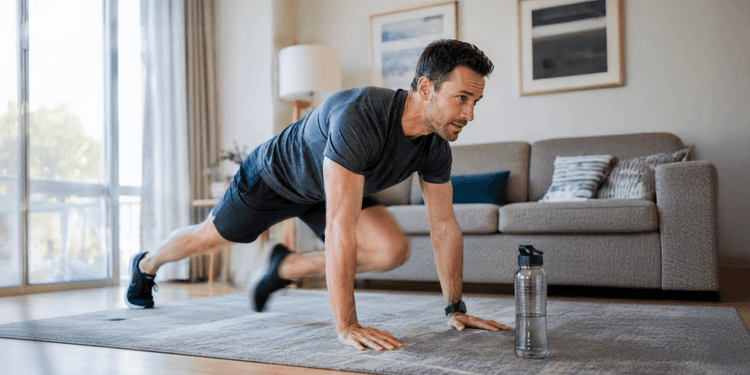
The standard pushup builds your entire upper body and trains core stability at the same time. Start in a high plank position with hands flat on the floor slightly wider than shoulder width. Arms extended. Legs straight behind you. The body in a direct line from head to heels. Lower your chest toward the floor by bending your elbows. Push back to the starting position while squeezing your shoulder blades to keep your back tight. Elbows should track at about a 45-degree angle from your body, not flared wide.
Target: 3 sets of 8 to 12 reps. Too hard? Place your hands flat on a sturdy chair or wall to reduce the load.
2. Bodyweight Squat (Legs, Glutes)
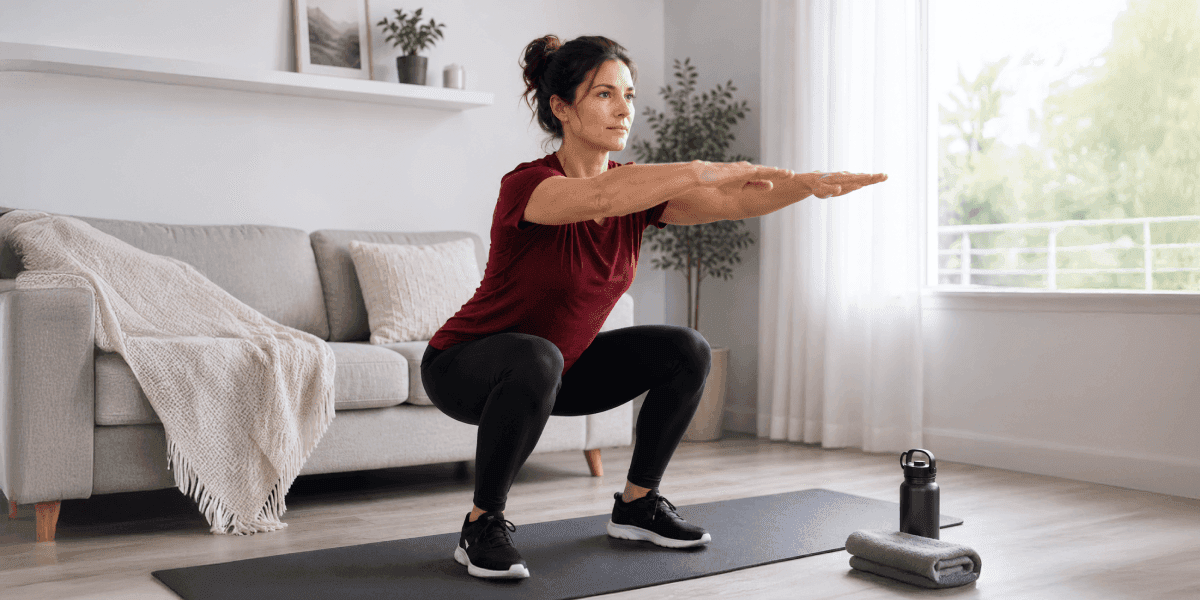
In a single move, the bodyweight squat trains your hamstrings, quads, and glutes. Stand up. Feet shoulder width apart. Toes pointed slightly out. Bend your knees until your thighs are parallel to the floor while pushing your hips back as if sitting into a chair. Keep your chest up and weight in your heels. Knees over your toes. To get back to the starting position, drive through your feet flat on the ground.
Target: 3 sets of 12 to 15 reps. Make it harder: pause for 2 seconds at the bottom of each rep, or add a small jump on the way up.
3. Reverse Lunge (Legs, Balance)
Lunges build single-leg strength and challenge your balance, which carries over into walking, stairs, and almost every athletic movement. Stand up with feet hip width apart. Step forward, your right foot first (or left, if you so prefer). For the reverse version, step your left foot back and lower your back knee toward the floor while keeping your front knee stacked over the ankle. Go back to the starting position by pushing through your front heel. Switch to the other leg.
Target: 3 sets of 8 reps per side. For extra challenge, hold a heavy book or backpack at your chest.
4. Plank Hold (Core, Shoulders)
To build the deep core strength that protects your back and stabilizes every other movement, include the planks in your routine. Get into a high plank position: hands flat on the floor under your shoulders, arms extended, legs straight, and knees straight behind you. Squeeze your glutes and core so your body forms one long line from head to heels. No sagging hips, no tail in the air. Breathe steadily through your nose.
Target: 3 sets of 20 to 45 seconds. Easier version: drop to your knees in plank position, keeping the same body line from head to knees.
5. Glute Bridge (Glutes, Hamstrings, Lower Back)
Most people sit too much, which leaves their glutes weak and their hips tight. Glute bridges fix that. Start lying on your back. Knees bent. Feet flat on the floor about hip width apart. Arms extended at your sides with palms down. Drive through your heels and lift your hips until your body forms a straight line from shoulders to knees. Squeeze your glutes hard at the top. Lower carefully.
Target: 3 sets of 12 to 15 reps. Progress to single-leg glute bridges by extending one leg straight as you lift your hips. Switch to the opposite leg each set.
6. Bird Dog (Core, Back, Balance)
This exercise is highly effective for core stability. Compared to planks, bird dog adds a limb movement to a stable spine. Start on all fours with hands under shoulders and knees under hips. Extend your right arm forward and your left leg straight back at the same time. They should be both parallel to the floor. Hold for 2 seconds. Return to the starting position, then repeat with the opposite arm and leg.
Target: 3 sets of 8 reps per side. Focus on keeping your hips level. No twisting, no wobbling.
A seventh option to add once these get easy: the hollow hold. Start lying on your back. Lift your shoulders and feet off the floor. Squeeze your core to hold a slight banana shape with arms extended overhead and legs straight. Aim for 3 sets of 15 to 30 seconds. The hollow hold builds the deep core tension you need for harder bodyweight exercises down the line.
Your First 4-Week Home Workout Plan
Use the 3-3-3 rule: 3 sets per exercise, 3 workouts per week, 3 weeks per routine before increasing the difficulty. Here is what that looks like in practice.
Week 1-2: Foundation Phase
Train Monday, Wednesday, and Friday. Rest at least one full day between sessions so your muscles can recover.
Exercise | Sets | Reps or Time | Rest |
|---|---|---|---|
Pushups (or knee version) | 2 | 6 to 10 | 60 sec |
Bodyweight Squats | 2 | 10 to 12 | 60 sec |
Reverse Lunges | 2 | 6 each leg | 60 sec |
Plank Hold | 2 | 20 to 30 sec | 60 sec |
Glute Bridges | 2 | 10 to 12 | 60 sec |
Bird Dog | 2 | 6 each side | 60 sec |
Focus on form. A few clean reps beat sloppy ones every time.
Week 3-4: Building Phase
Same exercises, same 3 days per week, but you add a set and shorten the rest.
Exercise | Sets | Reps or Time | Rest |
|---|---|---|---|
Standard Pushup if ready | 3 | 8 to 12 | 45 sec |
Bodyweight Squats | 3 | 15 to 18 | 45 sec |
Reverse Lunges | 3 | 8 each leg | 45 sec |
Plank Hold | 3 | 30 to 45 sec | 45 sec |
Glute Bridges (single-leg if able) | 3 | 12 to 15 | 45 sec |
Bird Dog | 3 | 8 each side | 45 sec |
Shorter rest pushes your heart rate higher, which adds a light cardio component and supports weight loss when you eat at a slight calorie deficit (if weight loss is your goal).
How to Make Your Bodyweight Workout Harder Over Time
Bodyweight exercise can keep challenging you for years if you know how to scale difficulty. Here are four progression methods that actually work:
Add reps. Go from 8 reps to 12, then 15. Adding one rep each session compounds fast.
Slow the tempo. Slowly lower for 3 seconds on every rep to increase time under tension on each rep.
Reduce rest. Cut rest from 45 seconds to 30, then 20.
Harder variations. Move from standard pushup to decline pushup (feet on a chair) toward eventual one arm pushup work. Bodyweight squats become jump squats. Glute bridges become single-leg glute bridges.
Pick one progression every 2 to 3 weeks. Trying to change everything at once breaks your form and stalls your progress.
A short circuit-style home workout adds another dimension. Run through all 6 exercises back to back with 15 seconds rest between them, then rest 60 seconds and repeat 2 to 3 times. This trains cardiovascular fitness and strength in the same session, similar to HIIT. High-intensity interval training (HIIT) is effective for developing cardiovascular fitness and fat loss.
Common Beginner Mistakes to Skip
Skipping the warm-up. Cold muscles tear more easily. A 5-minute warm-up saves you weeks of recovery.
Sacrificing form for more reps. 8 clean reps with a straight line from head to heels beats 15 sloppy ones with sagging hips. Focus on proper form rather than speed during exercises to prevent injury and ensure effective workouts.
Training every day. Your muscles grow during recovery, not during exercise. Three days per week with full rest days between are enough to build muscle and avoid burnout.
Going too hard too fast. The 3-3-3 rule exists for a reason. Spend 3 weeks at each level before progressing to harder variations.
Expecting visible changes in a week. Strength gains show up in 2 to 3 weeks. At least 6 to 8 weeks of regular training paired with healthy nutrition bring visible changes. Patience is part of the plan.
Start Your First Home Workout Today
If you want a workout plan that adjusts to your fitness level, schedule, and goals, MadMuscles can build one for you in 4 minutes. Take a quick quiz to get a personalized bodyweight workout with video demonstrations and voice-guided instructions. The difficulty level will adapt as you get stronger to keep it challenging and fun.
Pick one exercise from the list above and try 3 sets right now. That first set is the only hard part.