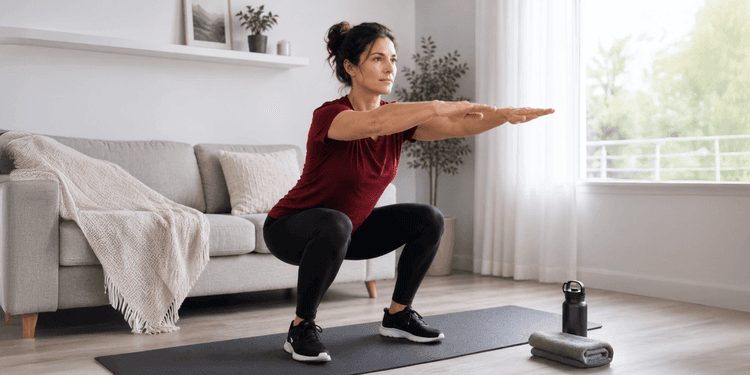


Why Working Out at Home Actually Works
You do not need a gym. You do not need a rack of dumbbells. You do not even need a yoga mat if your floor is clean enough. Working out at home strips fitness down to its real components: a body, some space, a plan you can actually stick to, and a goal that you set for yourself.
The convenience matters more than people admit. No commute, no waiting for equipment, no self-conscious moment in front of mirrors. You finish before most gyms open. That removes the single biggest excuse people use to skip workouts.
Home training also costs nothing. Bodyweight exercises like push ups, squats, lunges, and planks build real strength without a single piece of gear. According to the CDC Physical Activity Guidelines for Americans, adults need at least 150 minutes of moderate intensity activity or 75 minutes of vigorous activity weekly, plus muscle strengthening on 2 or more days. That entire prescription fits inside a home gym that takes up zero square feet.
Here is the part most beginners miss: bodyweight training can build muscle mass. Progressive overload, the principle of consistently challenging your muscles to get stronger, drives growth whether you use a barbell or your body weight. You add reps, slow the tempo, move to harder variations. Same principle, different load.
Who This Guide Is For
Three kinds of people get the most from this article. Anyone restarting fitness after a long break. Anyone who travels often and needs a routine that works in a hotel room. And anyone tired of paying for a gym they barely use. You do not need experience or current fitness. Every exercise includes a harder progression and an easier modification.
What You Need to Get Started
The Equipment Side
Nothing. Really, nothing. The core program runs on body weight alone.
If you want a few upgrades later, a yoga mat helps for floor work, a resistance band adds variety, and a sturdy chair opens up dips and elevated push ups. A pull-up bar mounted in a doorframe makes pulling exercises possible, which the average living room cannot otherwise replicate.
The Space Side
A patch of floor roughly 6 feet by 6 feet is all you need. Enough to lie down with arms extended overhead and legs straight. If your living room qualifies, you are all set.
Clear the area to give yourself a clear sightline. Slipping or knocking into furniture is the most common reason home workouts go badly.
Warm Up Before Every Session
Skip the warm up and you set yourself up for tight muscles, weaker output, joint stress, and even possible injury. Five minutes of dynamic movement is enough to wake everything up. Dynamic movements prepare muscles and elevate heart rate before workouts.
Try this sequence. 30 seconds of jumping jacks. 30 seconds of arm circles, forward then back. 30 seconds of leg swings on each leg. 30 seconds of hip circles. 30 seconds of light, controlled bodyweight squats. 30 seconds of high knees.
Dynamic movement beats static stretching before training. Save the long hamstring holds for afterward.
Full Body Workout Exercises You Can Do Right Now
The exercises below cover every major movement pattern: push, squat, hinge, core, and dynamic. Combined, they train your upper body, lower body, and abs in a single full body workout. Each one can scale up or down based on your starting point.
Push Ups
Push ups build your chest, shoulders, and triceps in one of the most efficient upper body exercise patterns ever invented. Your starting position is a high plank: hands shoulder width apart, a straight line from head to heels. Lower your chest toward the floor by bending your elbows at roughly 45 degrees, keeping your core tight and your hips from sagging. Push back up to the starting position with arms extended.
Aim for 3 sets of 8 to 12 reps. To make it easier, drop to your knees or place your hands on a sturdy chair. To make it harder, slow the lowering phase to 3 seconds or move to decline push ups with feet flat on a step.
Bodyweight Squats
Squats are the foundation of all lower body training. They work your quads, glutes, hamstrings, and calves while training your core to keep you upright. Stand with feet shoulder width apart, toes pointed slightly out. Imitate sitting into a chair: bend your knees, pushing your hips back. Lower your body until your thighs are parallel to the floor. If it's too hard, then as low as you can go with control. Drive through your heels to stand back up.
Aim for 3 sets of 12 to 15 reps. To make it more challenging, pause 2 seconds at the bottom of each rep, or progress to single leg squats holding a chair for balance.
Reverse Lunges
Reverse lunges train one leg at a time, which exposes imbalances and builds unilateral strength most bilateral movements skip. Stand tall in a standing position with feet hip width apart. Step forward feels harder on the knees, so step one foot back instead and lower your back knee toward the floor while your front knee bends to roughly 90 degrees. Push through your front heel to return to the starting position, then switch to the opposite leg.
Aim for 3 sets of 10 reps per side. To make it more difficult, add a knee drive at the top or hold a heavy object close to your chest.
Plank
The plank engages the core muscles and is a fundamental exercise in bodyweight training. Set yourself in a pushup position on forearms, elbows directly under your shoulders, body in a straight line from head to heels. Squeeze your glutes. Brace your abs. Hold. Do not let your hips sag or pike up toward the ceiling.
Aim for 3 sets of 30 to 60 seconds. For a harder version, lift one foot off the floor or extend the opposite arm forward while keeping the body stable.
Mountain Climbers
A cardiovascular exercise performed in a high plank position. Mountain climbers torch calories, train your core, and elevate your heart rate. Fast. Start in a high plank with arms extended and body stable. Drive one knee toward your chest, then quickly switch legs, keeping your hips low and core tight. Move controlled at first, then build speed.
Aim for 3 sets of 30 seconds. To make it more difficult, increase pace or add a push up between rounds.
Glute Bridges
Glute bridges target your glutes and hamstrings while opening up the tight hip flexors that come from sitting all day. Starting position: on your back, knees bent, feet flat on the floor, hip width apart, arms by your sides. Lift your hips by pressing through the heels. Your body should form a straight line from shoulders to knees. Squeeze hard at the top, then lower with control.
Aim for 3 sets of 12 to 15 reps. To make it more challenging, lift one leg straight in the air and bridge with the supporting leg only.
Bird Dog
Do this exercise to train cross body coordination, core stability, and lower back endurance. Start on hands and knees, wrists under shoulders and knees under hips. Extend one arm forward and the opposite leg back, at the same time keeping the body stable and hips square to the floor. Pause briefly, return, switch sides.
Aim for 3 sets of 8 reps per side. For a harder version, hold the extended position for 3 to 5 seconds each rep.
Hollow Hold
The hollow hold builds the deep core tension used in everything from push ups to handstand work. Start lying on your back. Press your lower back into the floor. Lift your shoulders and feet a few inches up. Extend your arms overhead. Your body forms a shallow banana shape. Hold without letting the lower back arch off the ground.
Aim for 3 sets of 20 to 30 seconds. To make it easier, bend knees and bring arms by your sides until your core gets stronger.
Burpees
The burpee is the most hated, yet most effective full body exercise on the list. Stand tall. Then lower into a squat in one quick move, plant your hands on the floor, spring your feet back into a plank, do one push up, drive your feet back to your hands, and then upward in an explosive jump. That is one rep.
Aim for 3 sets of 8 to 10 reps. To make it easier, step the feet back instead of jumping and skip the push up.
Sample Home Workout Routines
20 Minute Full Body Circuit (AMRAP)
Set a timer for 20 minutes. Move through the list with minimal rest, then start over. Goal: as many rounds as possible. AMRAP workouts are effective for home training. They allow you to perform a series of exercises continuously to improve endurance and strength.
• 10 push ups
• 15 bodyweight squats
• 10 reverse lunges per side
• 30 second plank
• 20 mountain climbers
• 10 glute bridges
Rest 60 seconds between rounds. This circuit works as a full body workout, a cardio session, and a muscular endurance test all at once.
HIIT Workout for Fat Loss
High intensity interval training combines short bursts of intense exercise with periods of rest. It is very effective for improving cardiovascular fitness and burning calories. HIIT compresses a lot of work into a small window.
Try 40 seconds of work, 20 seconds rest, for 4 rounds of these 4 moves:
• Push ups
• Bodyweight squats
• Mountain climbers
• Burpees
That is 16 minutes of work. You will feel it.
Strength Focused Session
When you want to build muscle rather than chase a sweat, slow things down. Use harder variations, longer rest, and full range of motion on every rep.
Push ups: 4 sets of 8 to 10 reps, 90 seconds rest
Bodyweight squats with 3 second negative: 4 sets of 12 reps
Reverse lunges: 3 sets of 10 per side
Plank: 3 sets of 60 seconds
Hollow hold: 3 sets of 30 seconds
Bird dog: 3 sets of 8 per side
This session takes 30 to 40 minutes. Quality of each rep matters more than total volume.
How to Build Muscle with Bodyweight Workout Training
Bodyweight workout training builds muscle when you apply progressive overload. The same principle that drives growth in the gym. Your body adapts to whatever you ask of it. To keep adapting, you keep asking for more.
Four ways to add load without adding weight: Increase reps over time, slow the lowering phase to 3 or 4 seconds, move to a harder variation (knee push ups to full push ups to decline push ups), or reduce rest between sets so each set is harder than the last.
Train each major muscle group at least twice a week. A full body exercise program three times a week hits this easily. Eat enough protein: aim for 1.6 to 2.2 grams per kilogram of body weight daily. Without protein, the stimulus from training has nothing to build with.
Can You Burn Belly Fat with Home Workouts?
Here is the honest answer: no exercise burns belly fat in one specific spot. You cannot crunch your way out of a thick midsection. Fat loss is a whole body process driven mostly by a calorie deficit.
What home workouts do is help create that deficit. A 20 minute HIIT session burns hundreds of calories. Strength training builds muscle that raises your resting metabolism, meaning you burn more even when sitting still. Combine that with eating roughly 300 to 500 calories below maintenance, and belly fat comes off along with body fat everywhere else.
Plank, hollow hold, and bird dog build a stronger core. The visible abs come from the eating side. Both halves matter.
A Weekly Home Workouts Schedule
Beginner Plan (3 Days a Week)
Train Monday, Wednesday, Friday. Each session takes 20 to 30 minutes. Rest on the days between, walking lightly if you feel like it.
Use the 20 minute circuit as your template. Start with 2 rounds, build to 4 over the first month. Track your reps so you can see progress on paper, not just in the mirror.
Intermediate Plan (4 to 5 Days a Week)
Train Monday, Tuesday, Thursday, Friday with an optional Saturday HIIT. Alternate days between the strength focused session and the HIIT workout. Saturday becomes a shorter circuit if you have energy left over from the week.
Add new workouts gradually. Swap a few exercises every 4 weeks to keep your nervous system challenged and your motivation high.
Common Mistakes That Wreck Home Workouts
Skipping the warm up. Cold muscles and stiff joints lead to strains. A five-minute warm up is non negotiable.
Stopping when it gets boring. Home training requires more discipline than a gym. No monthly fee shames you into showing up. Block the time on your calendar and treat it like an appointment.
Ignoring progression. Doing the same workout for months produces the same body for months. Track your reps, your hold times, your tempo. Push something forward every 2 to 3 weeks.
Training every day. Recovery is when adaptation happens. Muscles need 48 hours between sessions to rebuild. Three to five training days a week is plenty.
Doing only push and squat work. Pulling movements (rows on a sturdy table, doorway pulls with a band) matter for shoulder health and posture. Without a pull-up bar, find a way to get pulling in.
A Plan That Fits Your Schedule
If you want a complete home workout program instead of piecing one together yourself, MadMuscles builds one in about four minutes. Take a quick quiz and you get a plan matched to your fitness level, available time, and any equipment you have (or do not have). The app adjusts difficulty automatically based on how each session feels, so workouts get more challenging as you do.
Pick one exercise from the list above and try it right now. That first set is the only hard part.