
What Is Calisthenics?
Calisthenics is bodyweight training that builds functional strength, flexibility, and body control. The word comes from Greek meaning “beautiful strength.” You use natural movement patterns like pushing, pulling, squatting, and holding to develop your full body.
This style of training works for all fitness levels. Complete beginners can start with wall push ups or assisted squats. Advanced athletes can progress to handstand push ups, muscle ups, or front levers. The system scales to wherever you are right now.
Unlike weight training where you add plates to a barbell, calisthenics progression happens through leverage and angles. You change your body position to make exercises harder. A wall push up becomes an incline push up, then a full push up, then a decline push up. Your body weight stays the same but the challenge increases.
Research supports this approach. A 12-month study found that high-rep bodyweight exercise produced roughly 7.2 kg of lean muscle gain in untrained adults. Weight training produced slightly more at 8.7 kg, but bodyweight training had a much lower injury rate of 6% compared to 18%. You can build muscle with calisthenics alone. In fact, calisthenics is one of the most effective ways to build muscle using only your body weight.
Who Is This Guide For?
This guide serves three groups. First, people with zero fitness experience who feel intimidated by gyms or complex equipment. Second, former gym-goers transitioning to home workouts for convenience, travel, or budget reasons. Third, anyone wanting effective training without a gym membership or monthly fees.
Starting calisthenics can feel overwhelming. There are countless calisthenics exercises online, confusing progression systems, and fears about doing movements wrong and getting injured. You might not know where to begin or whether bodyweight exercise can actually help you build strength.
No prior experience is needed. The exercises in this guide start at the most accessible level and progress gradually. You will learn proper form before adding difficulty. The goal is building a strong foundation that supports long-term progress.
What You Need to Get Started
The beauty of home calisthenics is that you need almost nothing to begin. Comfortable workout clothes, enough floor space to lie down with arms extended, and optionally a yoga mat for cushioning. That covers the first 4 weeks of training.
As your calisthenics training progresses, a few pieces of equipment become useful. A pull up bar fits most doorframes and opens up many calisthenics exercises for your back and arms. A resistance band helps with assisted pull ups and adds challenge to bodyweight squats and glute exercises. Resistance bands cost very little and take up no space, making them ideal for home calisthenics workouts.
Later, gymnastic rings offer an advanced challenge for push ups, dips, rows, and muscle ups. Gymnastic rings hang from any pull up bar or ceiling mount and force your stabilizer muscles to work harder than fixed bars. A sturdy table works for inverted rows. You can also use the edge of a counter or two chairs for dips.
No gym or special gear is required to begin. In the MadMuscles app, you choose your equipment level during the initial quiz: no equipment, basic equipment (resistance band and dumbbells), or full equipment (resistance band, dumbbells, parallel and horizontal bars). The app then builds your calisthenics workout plan around what you actually have available.
How to Warm Up Properly
A dynamic warm-up before every session takes 5-7 minutes. This routine prepares your joints, increases blood flow, and reduces injury risk by over 70% according to research.
Perform 30 seconds of each movement:
Jumping jacks
Arm circles (forward and backward)
Hip circles
Bodyweight squats (light, controlled)
High knees
Target the muscles you will use. Wrist and shoulder circles prepare you for push ups and planks. Hip circles and squats prepare your lower body. Core activation happens naturally through these movements.
Skipping the warm-up leads to stiffness, reduced performance, and joint stress. Make this a non-negotiable part of your calisthenics workout routine.
6 Essential Beginner Calisthenics Exercises
Push Ups (Chest, Shoulders, Triceps)
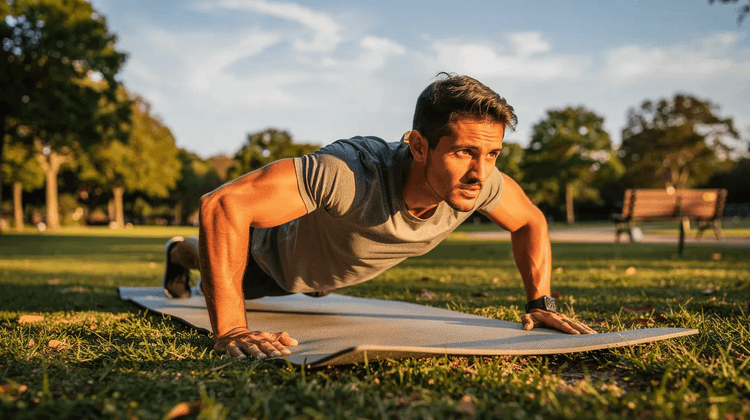
Start with wall push ups or incline push ups if full push ups feel too difficult. Place your hands slightly wider than shoulder width on a wall or elevated surface. Lower your chest toward the surface while keeping a straight line from head to heels. Push back to the starting position.
Form cues: elbows close to your body at a 45-degree angle, core tight, no sagging or piking at the hips. This great exercise builds upper body strength across multiple muscle groups.
Progression path: wall → incline → knee push ups → full push ups. Each step makes the movement harder by changing your body angle relative to the floor.
Target: 3 sets of 8-12 reps.
Bodyweight Squats (Quads, Glutes, Hamstrings)
Stand with feet shoulder width apart. Push your hips back and bend your knees, lowering until thighs are parallel to the floor. Drive through your heels to stand back up.
Form cues: keep chest up, weight on heels, knees track over toes. Look straight ahead, not down. This is one of the best exercises for lower body and full body strength.
Progression: assisted (holding a chair or doorframe) → bodyweight → pause squats (hold at the bottom for 2-3 seconds). Later progressions include pistol squats and cossack squats.
Target: 3 sets of 12-15 reps.
Inverted Rows (Back, Biceps)
Find a sturdy table or low bar. Lie underneath with your chest below the edge. Grip the edge with hands shoulder width apart. Pull your chest to the bar keeping your body straight like a plank, then lower with control.
Form cues: straight line from head to heels, squeeze shoulder blades together at the top, full range of motion on each rep. This exercise balances all the pushing work and builds serious upper body strength.
Progression: high angle (more upright, easier) → low angle (more horizontal, harder) → feet elevated.
Target: 3 sets of 8-10 reps.
Planks (Core, Shoulders)
Position yourself on forearms and toes with elbows directly under shoulders. Create a straight line from head to heels. Squeeze your glutes and core to hold this position.
Form cues: do not let hips sag toward the floor or pike up toward the ceiling. Toes pointed, neck neutral. Breathing stays steady.
Progression: knee plank → full plank → side plank. Each variation challenges core stability differently.
Target: 3 sets of 20-30 seconds, building to 60 seconds.
Assisted Dips (Triceps, Chest, Shoulders)
Place your hands on a chair or bench behind you, fingers pointing forward. Lower your body by bending elbows to 90 degrees with knees bent. Push back up to the starting position.
Form cues: keep elbows close to your body, shoulders down and back, control the descent. This builds the pushing strength needed for more advanced calisthenics movements like ring dips.
Progression: feet flat on floor (easier) → legs extended → feet elevated on another surface.
Target: 3 sets of 8-10 reps.
Knee Raises (Lower Abs, Hip Flexors)
Stand upright or hang from a pull up bar if available. Raise your knees toward your chest in a controlled motion. Lower back to the starting position without swinging.
Form cues: focus on contracting your lower abs to lift your knees, not momentum. Keep the movement smooth. This prepares you for other exercises like hanging leg raises and L sit holds. Knee raises are a staple in any calisthenics strength training routine.
Progression: standing knee raises → hanging knee raises → straight leg raises.
Target: 3 sets of 10-12 reps.
Your First 4-Week Beginner Calisthenics Plan
This full body calisthenics workout plan divides into two phases. Weeks 1-2 build your foundation with easier variations and lower volume. Weeks 3-4 increase difficulty and sets as your body adapts.
Week 1-2: Foundation Phase
Train 3 days per week with rest days between sessions (Monday, Wednesday, Friday works well). Use the easiest progression for each exercise. Focus entirely on good form.
Day | Exercise | Sets | Reps/Time |
|---|---|---|---|
Mon | Wall/Incline Push Ups | 2 | 6-8 |
Assisted Squats | 2 | 10-12 | |
High Angle Rows | 2 | 6-8 | |
Knee Plank | 2 | 20-30 sec | |
Assisted Dips (feet flat) | 2 | 6-8 | |
Standing Knee Raises | 2 | 8-10 | |
Wed | Same exercises | 2 | Same reps |
Fri | Same exercises | 2 | Same reps |
Rest 60-90 seconds between sets. This rest period allows full recovery for quality reps.
Week 3-4: Building Phase
Continue 3 days per week. Move to harder variations where you completed all reps with perfect form in weeks 1-2. Add one set to each exercise.
Day | Exercise | Sets | Reps/Time |
|---|---|---|---|
Mon | Incline/Knee Push Ups | 3 | 8-12 |
Bodyweight Squats | 3 | 12-15 | |
Lower Angle Rows | 3 | 8-10 | |
Full Plank | 3 | 30-45 sec | |
Assisted Dips (legs extended) | 3 | 8-10 | |
Knee Raises (hanging if possible) | 3 | 10-12 | |
Wed | Same exercises | 3 | Same reps |
Fri | Same exercises | 3 | Same reps |
Rest 45-60 seconds between sets. Shorter rest increases training density as your fitness level improves.
MadMuscles offers workouts designed specifically for beginners if you want guided programming with video demonstrations.
What Comes After the First Month
Once you complete 4 weeks of consistent calisthenics training, your body is ready for more challenging exercises. This is where calisthenics gets exciting because there are many calisthenics exercises to work toward as long-term goals.
Intermediate Calisthenics Exercises
Pistol squats (one foot squat): stand on one foot and lower yourself all the way down with the other leg extended forward. Pistol squats build serious strength in your quads, glutes, and stabilizer muscles. Start by holding a chair for balance, then progress to free-standing pistol squats.
L sit hold: sit on the floor with legs straight, place your hands beside your hips, and lift your entire body off the ground. The L sit develops core strength, tricep strength, and hip flexor endurance. Begin with a tucked L sit and extend your legs over time.
Archer push ups: widen your hand placement and shift your weight to one side as you lower. This builds the one-arm push up strength that many calisthenics athletes train toward.
Typewriter pull ups: move laterally across the bar at the top of each pull up. These build grip strength and lat control for more advanced calisthenics movements.
Advanced Calisthenics Exercises as Future Targets
Muscle ups (explosive pull up transitioning above the bar)
Handstand push ups against a wall, then freestanding
Front lever and back lever holds on a bar or gymnastic rings
Planche progressions starting from a tucked position
Many calisthenics exercises can be learned at home with minimal effort in setup but serious strength as the reward. The key is adding load progressively: increase reps, slow down the tempo, move to a harder angle, or add a resistance band for extra challenge. This principle of adding load through leverage and volume is what makes calisthenics different from weight training.
In the MadMuscles app, you can change your workout type to Calisthenics or Military Calisthenic, and the difficulty adjusts automatically based on how you rate each session. If calisthenics exercises feel too easy, the app suggests harder progressions for your next workout.
How to Progress Without Hitting a Plateau
Progressive overload drives results in calisthenics training just like resistance training. Your body adapts to challenges, so you must gradually increase difficulty.
Four progression methods work for bodyweight exercise:
Add reps - Go from 8 reps to 10, then 12
Reduce rest time - Cut rest from 90 seconds to 60 seconds
Move to harder variations - Progress from incline push ups to full push ups
Add tempo - Slow the lowering phase to 3-4 seconds (slow negatives)
Follow the 2-3 week rule. Stay at each progression for at least 2-3 weeks before advancing. Your tendons and connective tissue need time to adapt, even when muscles feel ready. Rushing leads to injury.
Do not skip progressions. Wall push ups exist for a reason. Mastering easier variations builds the strength and control needed for advanced calisthenics exercises like one-arm push ups or planche work.
The MadMuscles app adapts your workout plan automatically based on your logged performance, taking the guesswork out of progression.
Calisthenics also offers cardiovascular training benefits when you structure workouts as circuits. Perform calisthenics exercises back-to-back with minimal rest (15-30 seconds) for 3-4 rounds. This approach builds muscular endurance and cardiovascular fitness simultaneously. Many people assume bodyweight exercises only build strength, but circuit-style calisthenics keeps your heart rate elevated throughout the session.
Train different muscle groups with balanced programming. Pair pushing exercises (push ups, dips) with pulling exercises (rows, pull ups) and lower body work (squats, lunges). A well-rounded calisthenics routine targets all major muscle groups: chest, back, shoulders, arms, core, quads, hamstrings, and glutes.
As you build strength, try exercises on one foot or one arm to increase difficulty. Stand facing a wall for handstand practice. Start with your chest to the wall and hold for time. Wall-supported handstands build serious shoulder strength and prepare you for free-standing balance work. Strength training through calisthenics is about mastering your own body weight before adding external load.
Common Beginner Mistakes to Avoid
Skipping warm-up. Always do 5-7 minutes of dynamic movement before calisthenics movements. Cold muscles and joints perform poorly and sustain injuries more easily.
Sacrificing form for more reps. Quality over quantity applies to every set. Regress to an easier variation rather than complete reps with bad form. Ten wall push ups with perfect technique beat twenty sloppy full push ups.
Training every day without rest. Your muscles need 48 hours to recover and grow stronger. Three training days per week allows adequate recovery. Rest is when adaptation happens.
Ignoring pulling exercises. Many calisthenics beginners focus on push ups and squats while skipping rows and pull ups. This creates muscle imbalances and shoulder problems. Balance pushing and pulling work equally.
Expecting instant results. Strength improvements appear within 2-3 weeks. Visible changes in body composition take 6-8 weeks of consistent training with proper nutrition. Patience matters. Your body weight is the only resistance you need, and progressive calisthenics training ensures your own weight remains challenging at every stage.
Comparing to advanced athletes. Someone doing muscle ups or a human flag has trained for years. Their calisthenics skills developed over thousands of hours. Focus on your own progress, not social media highlights.
Nutrition Basics for Calisthenics Beginners
Protein supports muscle repair and growth. Aim for 1.6-2.2 grams per kilogram of body weight daily. Good sources include chicken, fish, eggs, dairy, legumes, and tofu.
Hydration affects performance directly. Drink 2-3 liters of water daily, more on training days or in hot weather.
Meal timing helps optimize your calisthenics workout. Eat a light balanced meal with carbs and protein 1-2 hours before training. Consume protein within 30 minutes after your workout to support recovery.
Sleep enables recovery. Aim for 7-9 hours nightly. Growth hormone release and muscle repair peak during deep sleep phases.
MadMuscles includes personalized meal plans that complement your workout program, making nutrition simpler.
Conclusion
Calisthenics is one of the most accessible and effective ways to build real-world strength. You need no gym membership, minimal equipment, and can train anywhere with floor space. The progressions scale from complete beginners to advanced athletes doing muscle ups and front levers.
Start with the 4-week plan in this guide. Stay consistent with your 3 sessions per week. Progress at your own pace using the methods described. A few months from now, movements that seem impossible today will become achievable.
The MadMuscles app offers personalized calisthenics programs adapted to your fitness level, so you always know what to do next. You can explore options like the Military Calisthenics program as you advance in your training.
Your journey in starting calisthenics begins with a single workout. Pick your first training day and begin.