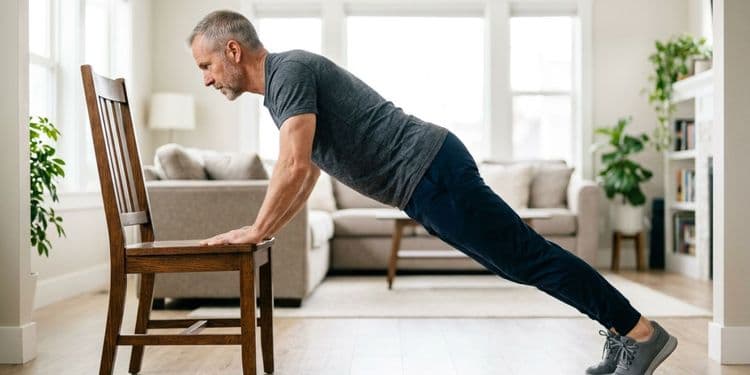

If you want stronger legs but cannot get down on the floor easily, a sturdy chair can be a perfect solution. Seated leg exercises let you build muscle, improve balance, develop flexibility, and boost circulation. All that while staying safely seated. They work for seniors and people recovering from surgery, office workers stuck at a desk and anyone whose knees, hips, or back say no thanks to standing workouts.
In this guide, you will find the best seated leg exercises. You'll learn how to do each one with proper form, and a simple weekly routine. No floor work, no fancy gear, just a sturdy chair and a little space.
What Are Seated Leg Exercises?
Seated leg exercises are strength and mobility moves you do while sitting in a chair. That makes your hips supported, your back upright, and your feet doing most of the work. The chair takes most of your body weight, so the load on your joints stays low while your leg muscles still get a real workout.
Muscles that matter most for everyday life are the main targets of the chair exercises. Quadriceps muscles for standing up, the hamstrings for walking, the calf muscles for climbing stairs, and the hip flexors for stepping over curbs. Your abdominal muscles and core muscles fire every time you lift a leg or hold one straight.
Why Seated Leg Exercises Are Worth Your Time
What exactly is the effect from seated leg exercises? Let's find out.
Better Balance and Fewer Falls
Regularly performing seated leg exercises can lower the risk of falls and injuries in older adults. They build the muscle strength you need to catch a slip or stand up without wobbling. Strengthening the muscles around the knee and hip gives those joints the support to keep you steady.
Real Lower Body Strength From a Chair
Sitting does not mean coasting. Seated leg extensions strengthen the quadriceps, which are essential for standing and climbing stairs. Seated calf raises improve lower leg strength and circulation. Seated marching engages your hip flexors and core for stability. Over a few weeks, the same moves get easier, and your leg strength grows with it.
Better Blood Flow, Less Swelling
Hours of sitting cause the blood pool in your lower legs. Regular movements like ankle pumps and seated marches promote blood flow and reduce swelling. They also help prevent blood clots in people with sedentary lifestyles. Small movements, big payoff.
Low-Impact and Joint-Friendly
For people with back pain, arthritis, or anyone recovering from surgery, seated exercises minimize stress on the lower back, knees, and hips. It makes them a safe yet effective alternative. You stay in control of how hard each rep feels. Nothing jars, nothing pounds.
Who Seated Leg Exercises Are For
Who gets the most direct benefit from these exercises? Seniors who want to enhance mobility and stay independent. The exercises rebuild the lower body strength needed to climb stairs, get out of a car, and stand up from the couch without help. People recovering from surgery use them to rebuild slowly without overloading healing joints.
Office workers tied to a desk use them to fight stiffness and swelling. Anyone with limited mobility, including people who use a wheelchair or live with chronic pain, can build strength without standing up. If you can sit upright, you can do these exercises.
What You Need to Get Started
A sturdy, armless chair without wheels, placed on a non-slip surface like a rug or carpet. The seat should let your feet rest flat on the floor with your knees bent at roughly 90 degrees. If the chair is too tall, slip a book or two under your feet. If it slides, move it onto something grippy. Wear loose clothing that lets your knees and hips move freely. A bottle of water nearby. That is the full list.
A Quick Word on Safety
Before starting any new exercise routine, consult a doctor, especially if you have recent injuries, balance problems, or any health issue that could be affected by exercise. This is not professional medical advice. A short conversation with your healthcare provider is the best first step.
Sit the Right Way Before You Start
Proper posture during seated exercises is essential both for the best result and injury prevention. Sit toward the front of the chair, not slumped against the back. Plant your feet flat on the floor. Feet hip width apart. Your ankles, knees, and hips lined up so a straight line could run through all three.
Pull your shoulders back gently. Keep your chest forward and tall. Engage your abdominal muscles just enough to feel them switch on. Hold this position throughout every exercise. If you start hunching, pause and reset.
Warm Up First (3 to 5 Minutes)
To increse flexibility, boost blood flow, and prepare your muscles for activity, do a short warm-up. Sit up and roll your shoulders forward and backward, five times each direction. Roll your ankles in slow circles, ten per foot. Lift your heels off the floor and lower them, twenty times. Finish with twenty light marches in place. Three to five minutes total.
12 Best Seated Leg Exercises
These twelve seated leg exercises hit every major muscle in your lower body. Pick five to seven per session and rotate which ones you do across the week.
1. Seated Marching
Seated marching targets hip flexors and engages the core for stability. Sit tall on the front of the chair. Feet flat and hands gripping the sides. Slowly lift one knee toward the ceiling as high as feels comfortable. Then lower it with control and lift the other. Keep your back straight and avoid leaning.
Goal: 3 sets of 20 reps total, 10 per leg. To make it harder, hold each knee up for two seconds at the top.
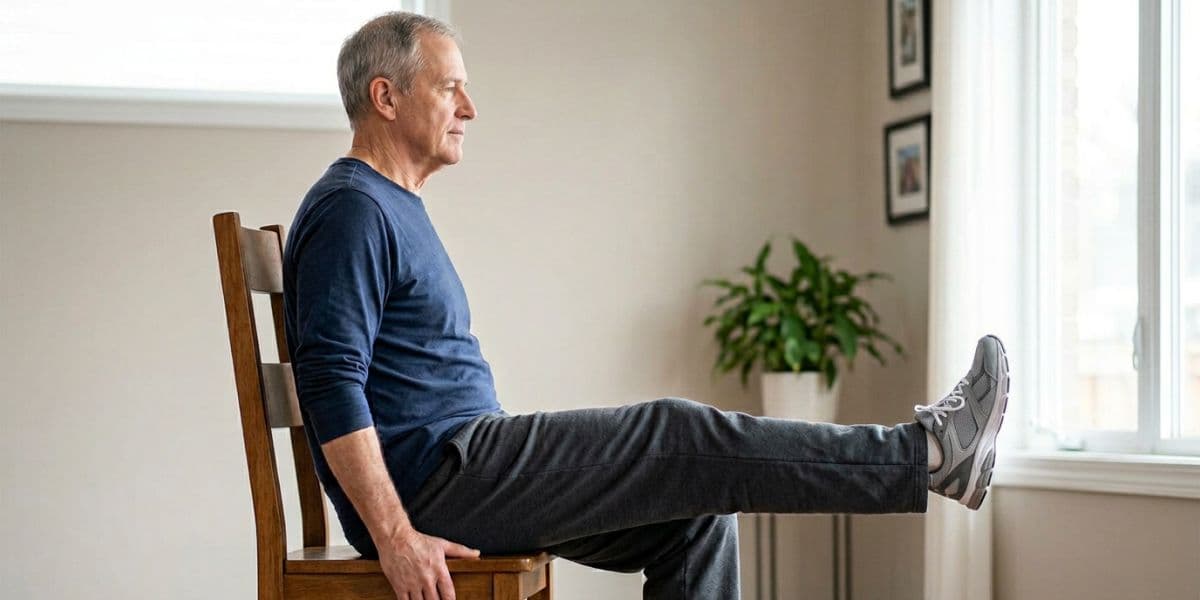
2. Seated Leg Extensions
To strengthen the quadriceps muscles, essential for standing and climbing stairs, do seated leg extensions. Sit tall with knees bent at 90 degrees. Feet flat. Lift and extend one leg straight in front of you carefully until your leg is parallel to the floor. Pause for a second, then slowly lower it back to the starting position. Switch sides.
Goal: 3 sets of 10 reps per leg. To make it more challenging, hold the extension for three seconds at the top.
3. Seated Calf Raises
Seated calf raises are an effective way to improve lower leg strength and circulation. Sit straight.Feet flat and knees bent. Press through the balls of your feet and slowly lift both heels as high as you can. Squeeze the calf muscles at the top for a second. Lower slowly.
Goal: 3 sets of 15 reps. To make it more strenuous, do one foot at a time.
4. Seated Toe Raises
To make walking and climbing stairs easier, include seated toe raises in your routine. They work the muscles on the front of the lower leg. Sit with feet flat and heels planted. Lift your toes with contro and the front of your feet toward the ceiling. Keep your heels down. Pause, then lower.
Goal: 3 sets of 15 reps. Pair with calf raises for a balanced lower leg session.
5. Seated Leg Circles
Seated leg circles improve hip and pelvic mobility. Sit tall and extend one leg straight in front of you. Slowly draw small circles in the air with your big toe. Ten in one direction, then ten in the other. Lower and switch sides.
Goal: 1 to 2 sets per leg. To make it harder, make the circles bigger and slower.
6. Seated Ankle Pumps
Tiny moves with a big payoff for circulation. Sit straight and lift one foot a few inches off the floor. Point your toes down. PThen pull them back up toward your shin in a steady rhythm. Ankle pumps promote blood flow and reduce swelling in the lower legs.
Goal: 20 pumps per foot. Great for breaks during long sitting sessions.
7. Seated Knee Lifts
Great exercise to engage multiple muscle groups including the hamstrings, quadriceps, and core. Sit up with feet flat. Lift one knee toward your chest as high as feels good, hold for a second, then lower with control. Switch legs. Keep your back straight and avoid swinging.
Goal: 3 sets of 10 per leg. To make it more challenging, lift both knees together.
8. Seated Inner Thigh Squeeze
Do this effective exercise to strengthen leg muscles you rarely target. Place a small pillow or rolled towel between your knees with both feet flat. Sit up and squeeze your knees together as hard as feels comfortable. Hold for five seconds. Release without letting the pillow drop.
Goal: 3 sets of 10 squeezes. Works the inner thigh and helps with everyday balance.
9. Seated Heel Slides
A gentle range-of-motion move for the knees and hamstrings. Sit tall with one foot flat on the floor. Slowly slide that heel forward along the floor until your leg is nearly straight. Then slide it back. Keep your heel on the ground the entire time. Switch sides.
Goal: 3 sets of 10 reps per leg. Excellent if you have stiff joints or are recovering from knee surgery.
10. Sit-to-Stand (Chair Squats)
Sit-to-stands using a chair are excellent for improving mobility and balance. Sit tall toward the front of the chair. Feet flat and feet hip width apart. Lean your chest forward slightly. Push through your heels and stand up all the way to a standing position. Slowly lower yourself back to seated with control. Use your hands on the chair for help if you need it.
Goal: 3 sets of 8 to 10 reps. To make it more strenuous, cross your arms over your chest.
11. Seated Leg Crosses
This move targets the inner thigh and outer hip in one go. Sit tall and extend both legs out in front of you. Heels on the floor. Lift them a few inches off the floor. Cross your right leg over your left. Switch. Continue alternating in a smooth scissor motion.
Goal: 3 sets of 20 crosses total. Lower your feet and rest a few seconds between sets.
12. Seated Side Leg Lifts
A gentle hip strengthener that works the outer thigh. Sit up with feet flat and knees bent. Slowly lift one leg out to the side. Keep the knee bent and the foot off the floor. Lower it back with control. Switch sides.
Goal: 3 sets of 10 per leg. Keep your torso upright. Leaning to compensate loses the point of the move.
A Simple Weekly Routine
For best results, seated leg exercises should be performed 2 to 3 times a week, starting with 10 to 15 minute sessions and increasing as your fitness level improves. Pick 5 to 7 exercises per session.
Monday: Warm-up; seated marching; leg extensions; calf raises; sit-to-stand; ankle pumps. 3 sets each.
Wednesday: Warm-up; knee lifts; toe raises; leg circles; inner thigh squeeze; heel slides. 3 sets each.
Friday: Warm-up; a mix of your favorites plus side leg lifts. 3 sets each.
Rest days in between give your muscles room to adapt. Three sessions a week is a great tool for building a habit you can actually keep.
Common Mistakes to Avoid
Slouching halfway through. Posture matters as much as the reps. If you catch yourself hunching, reset and keep going.
Holding your breath. Breathe naturally. Exhale on the harder part, inhale on the easier part.
Rushing the reps. Slow and controlled builds more strength than fast and sloppy.
Skipping the warm-up. Three minutes saves you from stiff joints.
Pushing through real pain. Mild muscle work is normal. Sharp joint pain is not. Stop and talk to your healthcare provider.
How to Progress Over Time
When the basic versions feel easy, you have a few ways to challenge yourself. Add an extra set. Slow each rep down. Add a two-second hold at the hardest position. Loop a resistance band around your shin or use a light ankle weight. Switch from two-leg moves to single-leg versions.
Strength gains in beginners and seniors usually show within 3 to 4 weeks of consistent practice. Stairs feel easier. Standing up feels lighter. You wobble less.
Start From Your Chair Today
You do not need a gym, weights, or even much space. A sturdy chair, ten minutes, comfortable outfit, and a little patience build real strength and improve overall well being from right where you are sitting.
If you would like a personalized seated routine that adjusts to your fitness level and any limitations, MadMuscles can build one for you in a few minutes. Take a quick quiz to get a chair-friendly program with video demonstrations, voice-guided instructions, and gentle progression that meets you where you are.
Pick one move from the list above and try it today. That is the only hard part.