
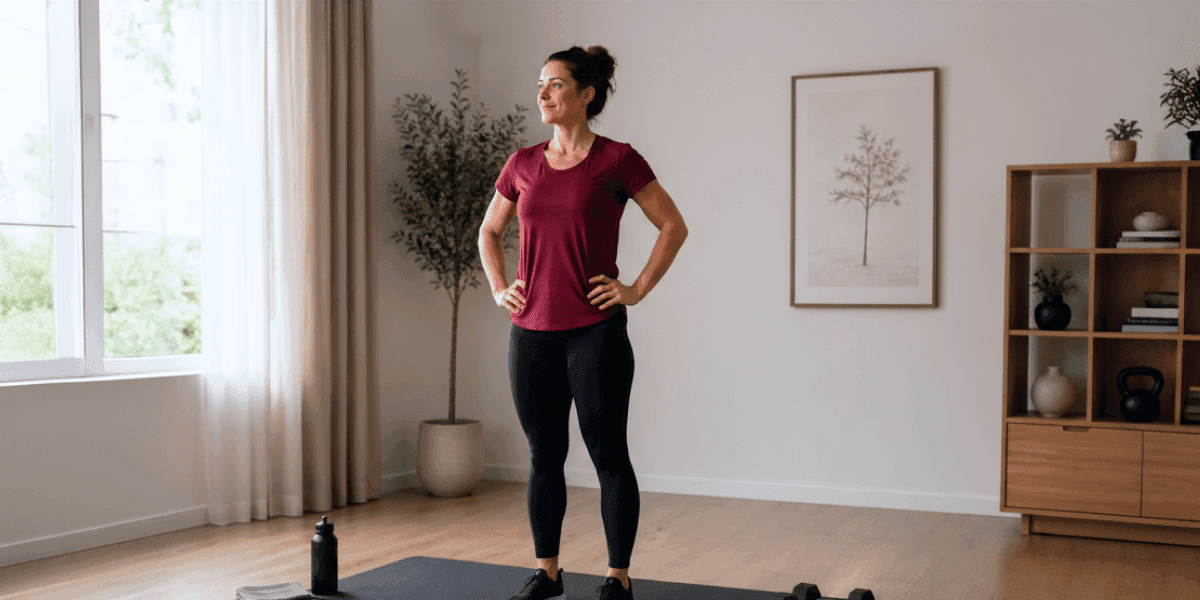
Why At-Home Workouts Work for Women
You do not need a gym to get stronger. You do not need fancy equipment, a trainer, or even much space. A patch of floor next to your couch is enough to build real muscle, raise your heart rate, and feel like yourself again.
This guide is for women who want to work out at home and actually mean it. You will find 8 foundational exercises that hit your full body, a 4-week plan that scales with you, a quick warm up routine, and answers to the questions that usually confuse beginners. No commute. No locker room. Just you, a little space, and a will to get on a fitness path.
Home workouts strip away the parts of fitness that stop most women before they start. No gym intimidation, no schedule to juggle, no mirror full of strangers. You can train barefoot in a t-shirt at 9 pm if that is when the kids finally fall asleep.
Your body weight is enough resistance to build strength. Push-ups, bodyweight squats, glute bridges, and planks work multiple muscle groups at once. They build muscle, support bone density, improve your stamina, and develop the everyday strength that makes carrying groceries or climbing stairs feel less like a chore. A Harvard Health review of a 10-week bodyweight program in young women found improvements in 7 of 9 fitness markers, including aerobic capacity, core endurance, lower-body power, and flexibility.
According th the Physical Activity Guidelines for Americans recommendation, you should perform at least 150 minutes of moderate-intensity exercise or 75 minutes of vigorous-intensity exercise per week. That breaks into five 30-minute sessions, or three 50-minute ones, or whatever shape fits your week. You do not need a perfect plan. You need one you will actually finish.
What You Need to Get Started
Here is the full kit:
Comfortable clothes that let you move
Roughly 6 by 6 feet of floor space
Optional: an exercise mat for floor work
Optional: a sturdy chair for incline push-ups and balance support
Optional: resistance bands if you have a pair already
No dumbbells. No exercise equipment beyond a mat. Every workout in this guide uses only your body weight as resistance.
5-Minute Warm Up Before Every Session
Skip this and your first set will feel rough. Five minutes gets blood into your muscles and warms up your joints. Run through this sequence:
30 seconds of jumping jacks
30 seconds of arm circles, forward and backward
30 seconds of hip circles in each direction
30 seconds of light bodyweight squats with feet shoulder-width apart
30 seconds of high knees
60 seconds of cat-cow stretches on hands and knees
Save the long static stretches for after the workout. Before training, you want movement.
8 Core At-Home Workouts for Women
These 8 exercises hit your upper body, lower body, and core in every session. Start with the easiest version of each. Move to the harder option when reps feel manageable.
Bodyweight Squats
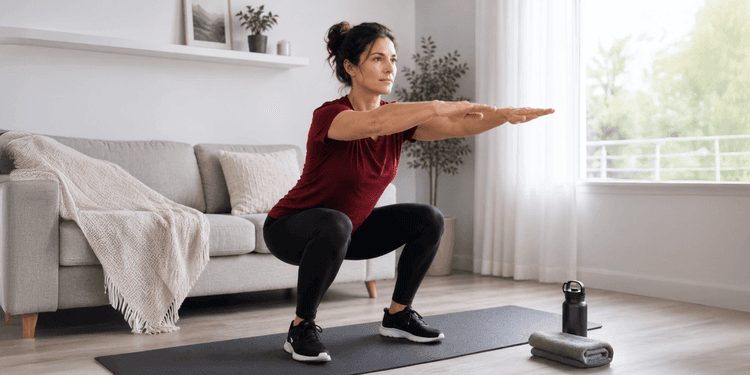
These exercises target the glutes, quads, and hamstrings, which is most of your lower body, in one move. Stand with feet shoulder-width apart, toes slightly pointed out. Push your hips back as if sitting into a chair. Bend your knees and lower until your thighs are roughly parallel to the floor. Keep your chest up and your weight in your heels. Drive through the floor to stand back up.
Aim for 3 sets of 12 to 15 reps.
Easier: hold a chair and go halfway down. Harder: pause at the bottom for 2 seconds.
Glute Bridge
If you spend your workdays at a desk, your glutes and hamstrings are asleep most of the time. To wake them up, do this exercise. Starting position: on your back. Knees bent and feet flat on the floor about hip-width apart. Lift your hips, pressing through the heels and squeezing your glutes. Your body should form a straight line from shoulders to knees. Hold for one breath. Then lower carefully.
Aim for 3 sets of 12 to 15 reps.
To progress, try the single leg bridge: lift your right leg off the floor, push through your left foot, and drive your hips up using one leg. Do all reps on the left, then switch and do the right leg.
Reverse Lunges
Reverse lunges build single-leg strength and balance without much stress on the knees. Stand tall with feet hip-width apart. Step your right foot back about two feet. Lower your right knee toward the floor until your left thigh is parallel to the ground. Your left knee should stay aligned over your left foot. Press through your left heel to come back to start.
Aim for 3 sets of 8 reps per side.
Easier: hold a wall for balance. Harder: slow the descent to 3 seconds.
Push-Ups
Push-ups are very effective for strengthening the chest, shoulders, and triceps, and your core has to fire the whole time to keep your hips from sagging. Wall push-ups are the friendliest start. Stand a couple of feet from a wall. Place your hands shoulder-width apart at chest height, and bend your elbows to bring your chest toward the wall. Push back to start.
Aim for 3 sets of 8 to 12 reps.
The progression starts from wall, then countertop, then incline on a chair, then knee push-ups, then full push-ups. Move down one step when you have 2 to 3 reps left in the tank.
Plank Shoulder Taps
They train your core and the small stabilizers in your shoulders. Start in a high plank with hands directly under your shoulders and feet wider than hip-width. Without rocking your hips side to side, tap your left hand to your right shoulder. Then return it to the floor. Tap your right hand to your left shoulder. Keep your hips square the whole time.
Aim for 3 sets of 10 taps per side.
Easier: drop to your knees. Harder: lift one foot a few inches off the floor as you tap.
Bird Dog
It is a full body move where you balance on one knee and one hand while you reach with the opposite arm and opposite leg. Get on all fours with hands under your shoulders and knees under your hips. Reach your right arm forward and extend your left leg straight back at the same time. Holding two seconds. Slowly return, then switch sides. The wobble is the workout.
Aim for 3 sets of 8 reps per side.
Easier: move one limb at a time. Harder: add a slow knee-to-elbow crunch between each rep.
Dead Bug
The dead bug looks silly and feels impossible at first, and this is exactly why it works. Lie on your back with knees bent at 90 degrees over your hips and arms reaching straight up over your shoulders. Slowly lower your right arm overhead and your left leg toward the floor at the same time. Keep your lower back pressed into the mat. Return to start. Repeat with your left arm and right leg.
Aim for 3 sets of 8 reps per side.
Easier: keep both knees bent the whole time. Harder: fully straighten the leg as you lower it.
Mountain Climbers
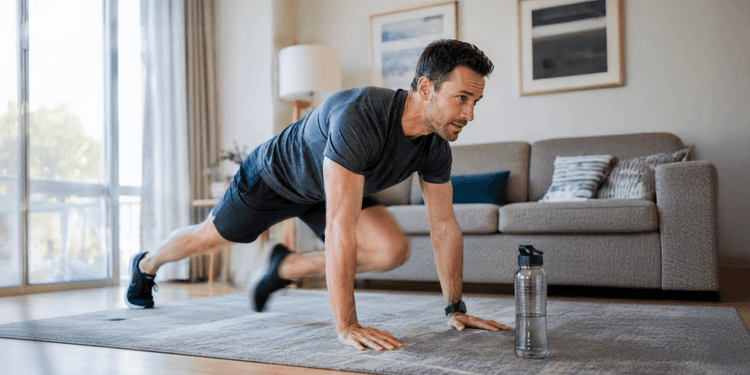
Need to add a cardio kick to your strength routine? Do mountain climbers. Start in a high plank. Drive your right knee toward your chest, then quickly switch and drive your left knee in. Pick up the pace until you are basically running in place on your hands. Keep your hips level. Do not let them bounce toward the ceiling.
Aim for 3 sets of 20 total taps (10 each leg).
Easier: slow the pace and step one foot at a time. Harder: do a push-up every 10 taps.
Your 4-Week Full Body Workout Plan
Train 3 days a week for the first two weeks. Take rest days between sessions. Your muscles grow on the rest days, not during the workout.
Week 1-2: Foundation Phase
Day | Workout | Sets | Rest |
Monday | All 8 exercises | 2 | 60-90 sec |
Wednesday | All 8 exercises | 2 | 60-90 sec |
Friday | All 8 exercises | 2 | 60-90 sec |
Pick the easiest progression of each exercise. Two clean sets beat three sloppy ones.
Week 3-4: Building Phase
Day | Workout | Sets | Rest |
Monday | All 8 exercises | 3 | 45-60 sec |
Wednesday | All 8 exercises | 3 | 45-60 sec |
Friday | All 8 exercises | 3 | 45-60 sec |
Saturday | Circuit: 45 sec work, 15 sec rest | 2 rounds | 60 sec |
Swap easier progressions for harder ones when they feel manageable. Wall push-ups become countertop push-ups. Two-leg bridges become single leg bridge work. Shorter rest also raises your heart rate, which, in turn, helps with weight loss while you build strength.
How to Keep Progressing After Week 4
Your body adapts to whatever you ask of it. Here are four ways to add load without buying any exercise equipment:
Add reps. Move from 10 to 12 to 15.
Slow the lowering phase. A 3-second descent on any squat or push-up is dramatically harder.
Shorten rest. Cut 90 seconds to 60, then to 45.
Move to the next variation. Wall to chair to knee to floor push-ups.
Pick one progression method at a time. Stay at each level for at least two weeks. Your tendons need that time even when your muscles feel ready.
Common Mistakes Women Make with Home Workouts
Skipping the warm up. Five minutes is not optional. Cold muscles do not perform well, and a warm up is where you catch the small niggles before they become injuries.
Training every single day. Rest is when your muscles repair and grow. Three days a week with rest between sessions beats seven days of half-effort.
Picking exercises by what looks impressive on Instagram. Wall push-ups, knee push-ups, and chair squats are not embarrassing. They are how you build the strength to do harder versions. Everyone starts somewhere.
Comparing your week 2 to someone else's year 3. Strength improvements show in 2 to 3 weeks. It takes 6 to 8 weeks of regular workouts to see visible changes in body composition. Trust the timeline.
Holding your breath. Exhale on the effort, inhale on the release.
Simple Nutrition for Recovery
Strength training does not work in a vacuum. You also need to eat enough. Protein around 1.6 grams per kilogram of body weight per day. For a 70 kg person, that is about 112 grams across all your meals. This sits in the 1.4 to 2.0 g/kg range recommended by the International Society of Sports Nutrition for exercising adults. Water at 2 to 3 liters per day, more if you sweat a lot. Sleep at 7 to 9 hours, since muscle repair happens at night. A small meal of carbs and protein 1 to 2 hours before training gives you fuel without sitting heavy in your stomach.
Honest remark: no specific food makes you lose belly fat. No exercise burns fat in one spot either. You cannot crunch your way out of a thick midsection. What works is a small calorie deficit, regular strength training, and time.
Start Today
You now have 8 exercises, a 4-week plan, and a warm up routine. Pick the easiest version of each move. Train 3 times this week. Note how you feel.
If you want a plan that adjusts to your body, your schedule, your fitness level, and your goals as you progress, MadMuscles can build one for you in a few minutes. Take a quick quiz to get a personalized full body workout plan with video demonstrations, voice-guided instructions, and exercises that swap in and out based on what you have at home.
Pick one move from the list above and try it today. Three squats counts. Let the fitness journey begin.