
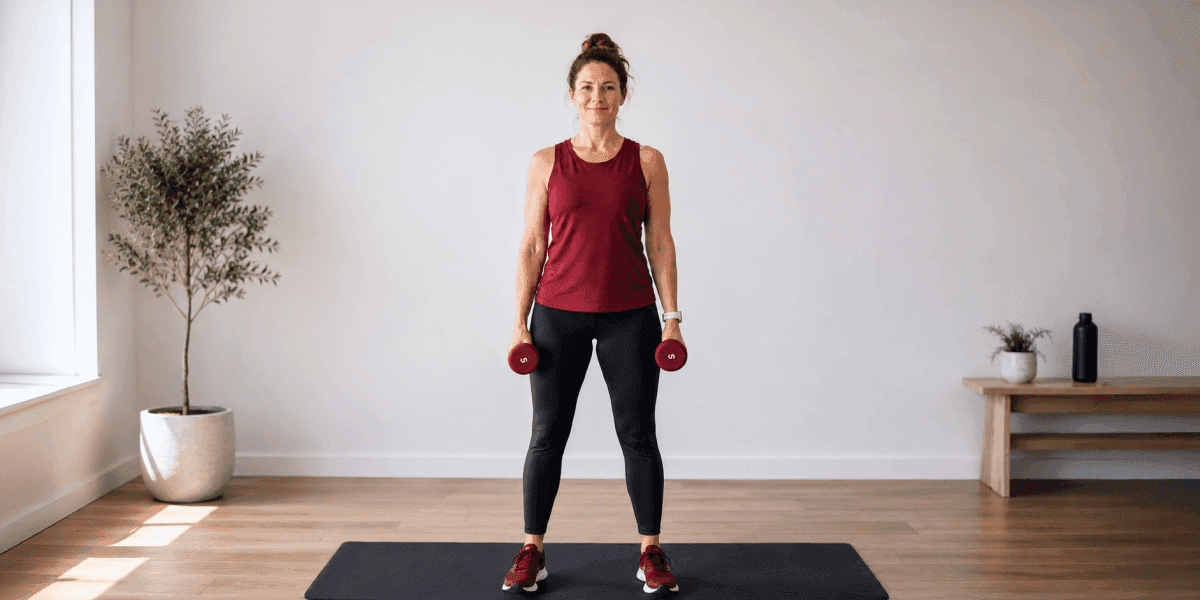
Why a Structured Beginner Workout Plan Beats Random Workouts
Walking into a gym for the first time can feel like showing up to a meeting where everyone else already knows the agenda. Gym intimidation, sometimes called gymtimidation, is a phenomenon known to many women. Fitness spaces just feel terrifying. Add the confusion about reps, sets, what to do on which day, and most new lifters quit before week three.
A structured fitness routine removes that overwhelm. Instead of guessing what to do, you follow a clear weekly schedule with the same exercises. If you do that long enough, you will get stronger at them. This guide gives you a full beginner workout plan with strength training, cardio, and recovery built in. Every move has a written walk-through, sets and reps, and an easier version if needed. No gym membership required.
Here is what makes this beginner workout plan different. You train all the major muscle groups across the week. You progress gradually using more reps, slower tempo, or light weights as your body adapts. And you give yourself enough rest days so your muscles can rebuild between sessions.
Strength Training Builds More Than Muscle
Strength training does far more than shape your arms or tighten your core. Regular strength training improves bone density, which matters for preventing osteoporosis and fractures as you age. It also helps regulate blood pressure and supports cardiovascular health.
The mental health side is just as real. Lifting weights, even light weights at home, can reduce symptoms of anxiety and depression and build self-esteem. Many women describe their fitness journey as much more about confidence than aesthetics. The functional fitness you build carries over into everyday life: carrying groceries, lifting kids, hiking with friends without your legs giving out at hour two.
Building lean muscle also raises your resting metabolic rate. More muscle means burning more calories at rest, which supports long-term weight management without crash dieting.
Why You Should Not Skip Cardio Workouts
Cardio gets a bad reputation in some fitness circles, but cardiovascular exercise is non-negotiable for heart health and stamina. Aim for 20-25 minutes of continuous movement per cardio session, two or three times per week.
The format can be anything you enjoy. Brisk walking, light jogging, cycling, swimming, jumping rope. The best cardio is the one you actually do.
Recovery Is Where the Real Work Happens
Here is the part beginners always miss. Muscles do not grow during your workout. They grow during recovery. When you train, you create small stresses on the muscle fibers. Rest, sleep, and nutrition rebuild those fibers stronger than before.
Rest days are non-negotiable for adequate recovery. Without them, you get diminishing returns at best and burnout or injury at worst.
Who This Beginner Workout Plan Is For
This complete plan works for several groups.
Complete fitness beginners with no exercise background will start with the easiest version of each move. No prior gym experience required.
Women returning to fitness after time off, whether due to pregnancy, work demands, or just life. The first two weeks are about relearning form, not chasing PRs.
Busy professionals who can only carve out 30-40 minutes per session. Every workout fits that window.
Anyone training at home with minimal equipment. The whole fitness regimen runs on a yoga mat and a pair of light weights.
Women easing into the gym for the first time. The plan translates directly to gym equipment if you have dumbbells, a bench, and maybe a cable machine.
What You Need to Get Started
The good news: very little.
Equipment for Home Workouts
For weeks 1-2, you need essentially nothing. Bodyweight is enough resistance to learn proper form and build a base. A yoga mat helps with floor work.
From week 3 onward, a pair of light weights makes a big difference. Most beginners do well starting with 3-pound or 5-pound dumbbells for arm work and 8-pound to 10-pound dumbbells for lower body moves. Resistance bands work too. Resistance training of any kind beats no resistance training.
A sturdy chair or bench helps for tricep dips, step-ups, and Bulgarian split squats. That is the entire equipment list.
Optional Gym Equipment
If you train at a gym, swap dumbbell moves for the equivalent machines. Lat pulldowns work in place of bent over rows. The leg press can replace some squat variations. Shoulder press machines work for the overhead press. None of this is required.
What to Wear
Anything that doesn't restrain your movements. Supportive shoes with a flat sole help with squats and lunges. Avoid running shoes with thick heel cushioning for heavy lower body work, because they make balance harder.
How to Warm Up Before Every Session
Skipping warm ups is one of the most common beginner mistakes. Cold muscles and stiff joints do not move well and increase injury risk. Five minutes of dynamic stretches before training prepares your body and protects your joints.
Your 5-Minute Dynamic Warm Up
Run through this sequence before every workout.
Movement | Duration | Focus |
Marching in place | 60 seconds | Raise heart rate |
Arm circles forward and backward | 30 seconds each | Shoulder mobility |
Bodyweight squats (slow) | 30 seconds | Lower body activation |
Hip circles | 30 seconds each direction | Hip mobility |
Walking lunges | 30 seconds | Glute and quad activation |
Cat-cow stretches | 30 seconds | Spine mobility |
Inchworms | 30 seconds | Full body warm up |
Move through each one without rushing. The goal is to increase blood flow and loosen joints, not get exhausted before you start. Quality warm ups make every set that follows feel more controlled.
Dynamic Stretches Beat Static Stretches Pre Workout
Static stretches, where you hold a position for 30+ seconds, are better saved for after your workout. Dynamic stretches that move through a range of motion warm up your joints and activate muscles without reducing power output. Save the static stretching for a cooldown.
Activating Your Major Muscle Groups
Pre-workout warm ups also activate the muscles you are about to train. Glute bridges before a leg day. Band pull-aparts before pressing work. These small additions improve your mind-muscle connection and make every set feel sharper.
Your Weekly Workout Schedule
Here is the structure most beginners thrive on.
How Many Days Per Week
3 to 5 workouts per week is the sweet spot for beginners. Less than three and you progress too slowly. More than five and you cut into recovery. This plan is based on four days per week, leaving three days for lighter activity or full rest.### Sample 4-Day Weekly Split
Day | Workout |
Monday | Lower Body Strength |
Tuesday | Upper Body Strength |
Wednesday | Rest or light walking |
Thursday | Full Body Strength Workout |
Friday | Cardio and Core |
Saturday | Light walking or yoga |
Sunday | Full Rest |
Feel free to shift the days to fit your schedule. The order matters less than the consistency.
Rest Days and Active Recovery
A rest day does not have to mean lying on the couch (though sometimes it should). Gentle movement like walking or light yoga can aid muscle recovery and keep you mobile. Aim for 7,000 to 10,000 steps on lighter days if you can. Easy movement improves blood flow to working muscles without stressing them.
If you ever feel run down, swap a training day for a rest day. Listening to your body is part of the plan, not a deviation from it.
The Complete 4-Day Beginner Workout Plan
This is your weekly workout schedule. Each session takes roughly 30 to 40 minutes including warm up. Rest 60 seconds between sets, which is the ideal rest period for most beginner-level work.
Day 1: Lower Body Strength
Exercise | Sets | Reps | Easier Option |
Bodyweight Squats | 3 | 10-12 | Hold a chair for balance |
Glute Bridges | 3 | 12-15 | Lift halfway, work up to full range |
Reverse Lunges | 3 | 8 each leg | Hold a wall for balance |
Calf Raises | 3 | 15-20 | Use a wall for support |
Plank Hold | 3 | 20-30 seconds | Drop to knees |
Day 2: Upper Body Strength
Exercise | Sets | Reps | Easier Option |
Push Ups (knees or full) | 3 | 6-10 | Incline push ups on a counter |
Bent Over Rows (dumbbells) | 3 | 10-12 | Use a resistance band |
Overhead Press | 3 | 8-10 | Lighter weight, seated |
Bicep Curls | 3 | 10-12 | Lighter weight |
Tricep Dips (chair) | 3 | 6-10 | Bend knees to reduce load |
Dead Bug | 3 | 8 each side | Keep feet on the ground |
Day 3: Full Body Strength Workout
This full body workout pulls the best lower and upper movements into one session.
Exercise | Sets | Reps | Easier Option |
Goblet Squats (or bodyweight) | 3 | 10-12 | Bodyweight only |
Push Ups | 3 | 6-10 | Knee or incline push ups |
Reverse Lunges | 3 | 8 each leg | Hold support |
Bent Over Rows | 3 | 10-12 | Light weights or band |
Plank to Downward Dog | 3 | 8 reps | Hold each position 2 seconds |
Bird Dog | 3 | 8 each side | Move arm and leg separately |
Day 4: Cardio and Core
Start with 20-25 minutes of continuous cardio. Walking briskly, light jogging, cycling, or jump rope all work. Finish with this core circuit:
Exercise | Sets | Reps/Time |
Plank Hold | 3 | 30 seconds |
Russian Twists | 3 | 20 total |
Dead Bug | 3 | 10 each side |
Glute Bridges | 3 | 15 |
Side Plank | 3 | 20 seconds each side |
Exercise Demonstrations: How to Do Each Move
Here is how to do every exercise in the plan with proper form. Read these once before your first session.
Bodyweight Squats (Quads, Glutes, Hamstrings)
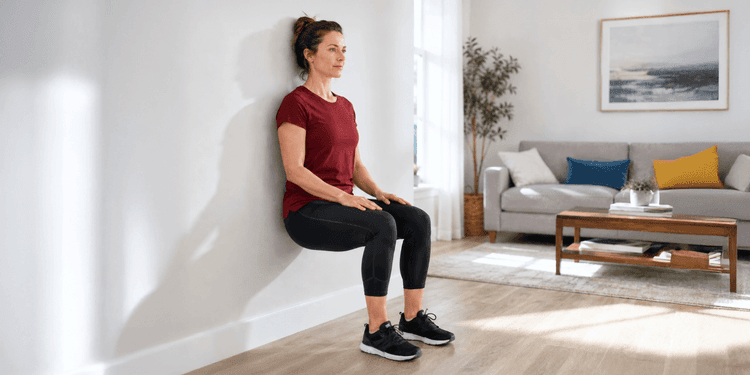
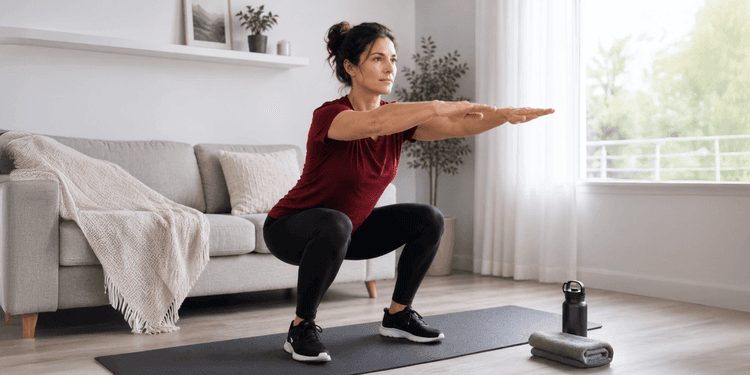
Bodyweight squats are a foundational movement pattern that trains multiple muscle groups at once: quads, glutes, hamstrings, and core. Stand tall. Feet hip width apart, toes pointed slightly out, and a soft bend in your knees as your starting position. Push your hips back and down as if sitting into a low chair. Keep your chest up and your knees tracking over your toes. Lower into a squat position slowly until your thighs are roughly parallel to the floor. To stand back up, drive through your heels.
Aim for 3 sets of 10-12 reps. To make it more challenging, pause for 2 seconds at the bottom of each rep or hold a pair of light weights at chest height.
Glute Bridges (Glutes, Hamstrings, Core)
These exercises target your glutes and hamstrings while also engaging your lower back and core. Lie on your back with your knees bent, feet hip width apart, and arms resting at your sides. Push through your heels and lift your hips until your body forms a straight line from your shoulders to your knees. Squeeze your glutes hard at the top. Slowly lower back down.
Aim for 3 sets of 12-15 reps. To make it harder, lift one leg straight out and perform single-leg glute bridges, 8-10 reps per side.
Reverse Lunges (Quads, Glutes, Balance)
To build single-leg strength while challenging balance and coordination, perform reverse lunges. Starting position: stand tall with feet hip width apart and knees slightly bent. Step your right foot back, lowering your right knee toward the floor while your left knee stays bent at about 90 degrees over your left foot. Drive through your left heel to return to standing. Repeat by stepping your left foot back so your right foot stays planted and your right leg does the supporting work.
Aim for 3 sets of 8 reps per leg. To make it more difficult, hold a pair of light weights at your sides.
Calf Raises (Calves)
They strengthen your lower legs and improve ankle stability. Stand with feet hip width apart and hands lightly on a wall or chair for balance if needed. Rise up onto the balls of your feet, lifting your heels as high as you can. Lower back down with control.
Aim for 3 sets of 15-20 reps. For a more strenuous variation, perform them one leg at a time.
Push-Ups (Chest, Shoulders, Triceps)
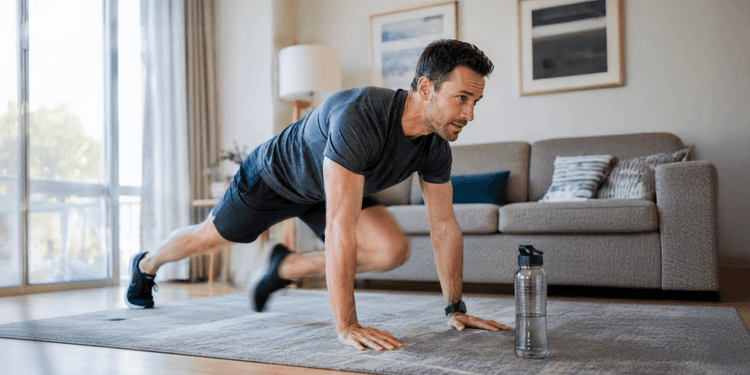
If you want to train your chest, shoulders, triceps, and core in one compound movement, push-ups are what you need. Start in a plank position with hands slightly wider than shoulder width and fingers spread. Your body is in a straight line from head to heels. Lower your chest toward the floor with elbows bent at roughly a 45-degree angle to your body. Keep your shoulder blades pulled together as you descend. Push through your palms back to the starting position.
Aim for 3 sets of 6-10 reps. If full push-ups are too hard, do knee push-ups or incline push-ups with your hands on a counter or chair. To make them harder, slow the lowering phase to 3 seconds.
Bent Over Rows (Back, Biceps)
Bent over rows are one of the best exercises for your upper back and biceps. They balance out all the pushing work in this plan. Hold a dumbbell in each hand with an overhand grip, feet hip width apart, knees slightly bent. Hinge forward at the hips until your torso is at roughly a 45-degree angle, with your back flat and your dumbbells hanging straight down in the starting position. Pull the dumbbells up toward your ribs. Squeeze your shoulder blades together at the top. Lower the weights with control.
Aim for 3 sets of 10-12 reps. To make it more challenging, increase the dumbbell weight or slow the eccentric to 3 seconds.
Overhead Press (Shoulders, Triceps)
Do this exercise to build shoulder strength and train overhead mobility. Stand with feet hip width apart. Hold a dumbbell in each hand at shoulder height with palms facing forward, elbows bent. Press the dumbbells straight overhead until your arms are fully extended (not locked). Lower back to the starting position under control.
Aim for 3 sets of 8-10 reps. To make it easier, perform it seated or use a single dumbbell with both hands. The shoulder press machine at a gym is a solid alternative.
Bicep Curls (Biceps, Forearms)
Bicep curls train your front upper arms. Starting position: stand with feet hip width apart, a dumbbell in each hand with palms facing forward, arms hanging by your sides as the starting position. Curl the dumbbells up toward your shoulders while keeping your elbows tucked at your sides. Lower the dumbbells back down without swinging.
Aim for 3 sets of 10-12 reps. The slower you lower, the more your biceps work.
Tricep Dips (Triceps, Shoulders)
These exercises target the back of your upper arms. Sit on the edge of a sturdy chair with hands gripping the seat beside your hips, fingers pointing forward. Slide your hips off the chair so your weight is on your arms, with knees bent at 90 degrees and feet flat on the floor. Lower your body with elbows bent to roughly 90 degrees. Push back up to start.
Aim for 3 sets of 6-10 reps. To make it harder, extend your legs straight out in front of you so you are working without bent knees.
Plank Hold (Core, Shoulders)
Training your entire core and teaching the body tension you will use in every other exercise. Start on your forearms and toes. Elbows directly under your shoulders. Body in a straight line from head to heels. Squeeze your glutes and abs to keep your hips level. Do not let your hips sag or pike up.
Aim for 3 sets of 20-30 seconds, building toward 60 seconds. If full planks are too tough, drop to your knees and maintain the same straight line from head to knees.
Dead Bug (Core, Stability)
Dead bug is a beginner-friendly core exercise. It teaches you to stabilize your spine while moving your arms and legs. Lie on your back with arms extended toward the ceiling. Knees bent at 90 degrees. Shins parallel to the floor. Lower your right arm overhead while extending your left leg until both are just above the floor. Return to start and switch sides.
Aim for 3 sets of 8 reps per side. To make it easier, keep your feet on the ground throughout.
Bird Dog (Core, Lower Back)
Do this exercise to train your core and lower back through controlled, opposing limb movement. Start on hands and knees with hands directly under your shoulders and knees under your hips. Extend your right arm forward while extending your left leg back. Keep your hips and shoulders square to the floor. Hold for 2 seconds. Return and switch sides.
Aim for 3 sets of 8 reps per side. Move slowly. Quality matters more than reps here.
Russian Twists (Obliques, Core)
Russian twists train rotational strength in your core. Sit on the floor with knees bent, feet flat or lifted off the ground, leaning back slightly so your torso is at roughly 45 degrees. Clasp your hands together (or hold a light weight) and rotate your torso side to side, tapping the floor beside each hip.
Aim for 3 sets of 20 total taps. To make it harder, keep your legs straight and lifted off the ground.
Side Plank (Core, Obliques)
Side planks build lateral core strength that standard planks miss. Lie on your side with your forearm flat on the floor. Elbow under your shoulder. Legs straight in a stacked line. Lift your hips so your body forms a straight line from head to feet. Hold the plank position with your core engaged.
Aim for 3 sets of 20 seconds per side. To make it easier, drop your bottom knee to the floor.
How to Progress Over Your First 8 Weeks
Progressive overload is what drives results. As your body adapts to the current exercise routine, you need to increase the demand step by step. Here is how to do it without overcomplicating things.
Weeks 1-2: Learning Proper Form
Your only job in the first two weeks is to learn each movement with clean technique. Use lighter loads or bodyweight only. Get comfortable with the movement patterns. If something feels off, go to the easier version.
Stick to the prescribed sets and reps. Do not add extra. Progressive overload starts later.
Weeks 3-4: Adding Reps
Once form is locked in, add 1-2 reps to each set. If the plan calls for 10 reps and they feel manageable, do 11 or 12. Keep the same weight or bodyweight level.
This is where most people start feeling a real difference in the exercise routine.
Weeks 5-6: Adding Weight or Difficulty
Now is when light weights enter the picture if you have not used them yet. For lower body work, start with 8-10 pound dumbbells. For arm and shoulder movements like overhead press and bicep curls, start with 3-5 pound dumbbells. The right starting weight should let you complete all reps with 2-3 reps left in the tank.
For bodyweight moves, progress by slowing the eccentric phase (the lowering part) or moving to a harder variation. Wall push-ups become incline push-ups. Incline push-ups become knee push-ups. Knee push-ups become full push-ups.
Weeks 7-8: Testing Your Progress
Use weeks 7 and 8 to retest your starting numbers. How many push-ups can you do now? How long can you hold a plank? How much weight can you lift on overhead press for 10 reps?
You should see meaningful improvements compared to Week one. Most beginners gain noticeable strength in their first 6-8 weeks of consistent training as the body adapts to regular loading.
Cardio Workouts for Beginners
Cardio supports your strength training rather than competing with it. Two to three short cardio sessions per week is plenty to round out a full body fitness routine.
Walking
Walking is the most underrated workout in fitness. A brisk 30-minute walk five days a week improves cardiovascular health, supports recovery, and burns calories without taxing your nervous system. If you do nothing else for cardio, walk.
Light Jogging
Once walking feels too easy, mix in light jogging for 1-2 minutes at a time during your walks. Most beginners overdo running early and end up with knee or shin pain. Slow build, every time.
Cycling
Cycling, indoor or outdoor, gives you 20-25 minutes of continuous movement with low joint impact. Good if you have knee issues.
Jump Rope and Light HIIT
Jump rope fits in a tiny space. Start with intervals: 30 seconds of jumping, 30 seconds of rest, for 10 minutes total. HIIT-style cardio workouts burn calories efficiently but should not replace all your cardio as they are harder to recover from.
Recovery and Rest Days
Why Rest Days Are Non-Negotiable
You should aim for at least one full rest day per week and ideally two. On a 4-day training week, that leaves space for lighter activity on the other days. Muscles repair and grow during rest periods, not during workouts.
Skipping rest does not speed up results. It slows them by limiting muscle repair.
Active Recovery Options
On easier days, do something gentle. A 30-minute walk. Light yoga. Easy bike ride. The goal is to keep your blood flow going without stressing your muscles.
Sleep and Muscle Repair
Sleep is when most muscle growth happens. Aim for 7-9 hours per night. If you consistently sleep less than 6, your strength training results will suffer no matter how hard you work in the gym.
How Long to Rest Between Sets
For most beginner strength training, rest 60 seconds between sets. For tougher compound movements like squats or push-ups, you may need 90 seconds. For circuits where you want to keep your heart rate elevated, drop rest time to 30 seconds.
Nutrition Basics for Your Fitness Journey
You cannot out-train poor nutrition. Here are the basics every beginner needs.
Protein Targets
Your goal protein intake is around 1.6 to 2.2 grams per kilogram of body weight daily. That is enough for building muscle and supporting recovery. For a 65-kilogram woman, it amounts to about 105 to 145 grams of protein across the day. Good sources: chicken, fish, eggs, Greek yogurt, tofu, lentils, and beans.
Hydration
Drink 2 to 3 liters of water per day, more on training days. Dehydration tanks both strength and recovery.
Pre and Post Workout Meals
Eat a balanced meal with carbs and protein 1-2 hours before training. A small snack like a banana with peanut butter works if you are training first thing.
After your workout, get protein within 60 minutes. Greek yogurt with fruit, a protein shake, eggs on toast. Nothing fancy.
Calorie Awareness
For weight loss, you need a modest calorie deficit (around 300-500 calories below maintenance). For building muscle, eat at maintenance or slightly above. Crash diets and training do not mix well.
Common Beginner Mistakes to Avoid
Skipping the warm up. Five minutes of dynamic stretches before training prevents weeks of recovery from a strain.
Going too heavy too fast. Start with light weights. Master the movement patterns. Add load gradually as your body adapts.
Training every day without rest days. Muscle growth happens during recovery. More is not always better.
Comparing yourself to people in their fifth year of training. Your progress is the only fair comparison. Track your own numbers, not theirs.
Cutting calories too aggressively. Eating too little kills both your energy in the gym and your recovery after. Building muscle requires fuel.
Holding your breath during reps. Exhale on the effort, inhale on the release. Steady breathing keeps your blood pressure stable and your form together.
Quitting too soon. Most beginners give up around weeks 3-4, right before changes start showing. Stick around. Your fitness journey gets meaningfully easier after the first month.
Overcoming Gym Intimidation
Gymtimidation is not just a word. It is a real barrier that keeps many women out of the weight room.
Here is what helps.
Start at Home
There is no rule that says you have to train at a gym. This entire beginner workout plan works at home with minimal equipment. Once you have built a base of strength and confidence, the gym feels like a tool, not a test.
Find a Workout Buddy
Exercising with a friend reduces intimidation and adds accountability. Even one gym buddy makes a difference in consistency.
Go During Off-Peak Hours
Most gyms are emptiest mid-morning and mid-afternoon on weekdays. Try training then if your schedule allows.
Bring a Plan
Walking into a gym with a clear plan beats wandering between machines. A structured workout routine on your phone removes the guesswork.
Tracking Your Progress
What to Measure
Track your workouts. Write down the exercise, sets, reps, and weight used. Over a few weeks, the numbers will tell the truth about your progress... or lack thereof.
Also worth tracking: how clothes fit, energy levels, sleep quality, and how you feel during workouts. Body composition shifts often show here before they show up on a scale.
When to Expect Results
Strength improvements typically appear within 2-3 weeks. You will notice you can do more push-ups, hold a plank longer, or lift a slightly heavier dumbbell. Visible muscle definition and body composition changes generally take 6-8 weeks of consistent training paired with proper nutrition.
Patience matters here. Most people quit right before results would have shown up.
Start Your Beginner Workout Plan Today
You have everything you need. A 4-day weekly schedule. Exercise demonstrations for every move. A clear 8-week progression. Cardio options, recovery guidelines, and basic nutrition guidelines.
If you would like a personalized version that adjusts to your fitness level, available time, and any limitations, MadMuscles can build one for you in about four minutes. Take a quick quiz to get a custom beginner workout plan with video demonstrations, voice-guided instructions, sets and reps that match your starting point, and automatic progression as you get stronger.
Pick one move from this guide and try it today. That first set is the only hard part. It only gets easier as you go. And more fun.