
Why Workouts at Home Work (Even Without a Gym)
People who train at home name convenience, privacy, and cost as the main reasons. No commute. No crowded weight room. No monthly membership. You push the couch back and you are already at the "gym."
The science backs this approach. Push ups, squats, and lunges engage multiple muscles at once and elevate your heart rate using just your body weight, which makes them effective for both strength and endurance. Bodyweight exercises can build muscle when you consistently challenge them to do a little more.
If you can stand up, sit down, and lie on the floor, you are fit to do these workouts.
What You Need to Start
Comfortable clothes that let you move. A patch of floor about the size of a yoga mat. Optional: a yoga mat for cushioning, and a sturdy chair you can grab for balance.
That is it. No dumbbells, no resistance bands, no pull-up bar. The MadMuscles app can build you a home workout plan around what you actually have. You just take a quiz and select "no equipment".
How Much Physical Activity Do You Actually Need?
The Physical Activity Guidelines for Americans recommend at least 150 minutes of moderate-intensity exercise per week, or 75 minutes of vigorous-intensity exercise, plus muscle-strengthening on 2 or more days that work all major muscle groups (CDC). That means roughly 30 minutes five days a week or three longer sessions if you prefer fewer training days.
For an absolute beginner, the sweet spot is 2-3 full body sessions per week with 48 hours of rest between workouts. This gives your muscles time to recover and your nervous system time to learn the movements. Training every day usually backfires within two weeks. Your body needs the rest as much as the work.
5-Minute Warm Up Before Every Session
A proper warm up takes five minutes and pays you back in better workouts and fewer aches. Skip it and your first reps feel stiff, your shoulders complain, your hips do not move the way they should, and your legs protest.
Run through this sequence: 30 seconds of marching in place with arms swinging, 30 seconds of arm circles (15 forward, 15 backward), 30 seconds of hip circles, 30 seconds of light bodyweight squats with knees slightly bent and feet shoulder width apart, and 30 seconds of leg swings (15 per side, holding a wall for balance). Finish with 60 seconds of slow shoulder rolls and gentle torso twists.
Warm muscles move better. Warm joints handle load better. Five minutes.
8 Bodyweight Exercises for Your First Home Workout
Here is the full breakdown of eight movements that train your entire body. Start with the easiest version of each. You can make any exercise harder once it feels too easy.
1. Wall Push-Up (Upper Body)
The wall push-up targets your upper body, chest, shoulders, and arms while teaching proper form for harder push up variations later. Stand facing a wall with your feet hip width apart, about an arm's length away. Place your hands on the wall at shoulder height, shoulder width apart. Arms straight in the starting position. Keep your body aligned from head to heels, bend your elbows to lower your chest toward the wall, then press back to start.
Do 3 sets of 8-12 reps. To make it more challenging, step back to a more horizontal angle, then progress to incline push-ups on a couch, then knee push-ups, then full push-ups from the floor.
2. Bodyweight Squat (Lower Body)
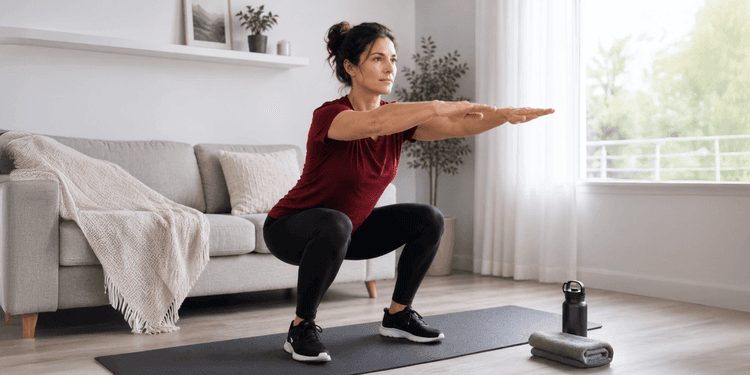
To train your quads, glutes, hamstrings, and lower back in one move, do bodyweight squats. Stand with feet shoulder width apart, feet flat, toes pointed slightly out. Send your hips back like you are sitting into a chair, bend knees, and lower until your thighs are roughly parallel to the floor. Keep your chest up, weight in your heels, and drive through the floor to return to standing.
Do 3 sets of 10-15 reps. If balance feels shaky, hold a chair for support. To make it harder, slow the descent to 3 seconds down or pause at the bottom.
3. Glute Bridge (Hips and Deep Core Muscles)
A glute bridge wakes up your glutes, hamstrings, and deep core muscles. Starting position: on your back with knees bent, feet flat on the floor hip width apart. Arms on the sides. Palms down. Lift your hips by squeezing your glutes and pressing through your heels. Your body should form one line from shoulders to knees. Hold for a second at the top, then lower with control.
Do 3 sets of 12-15 reps. To make it more difficult, lift one foot off the ground and perform single leg glute bridges, switching to the other leg each set.
4. Knee Plank (Core Engaged)
The plank position trains your core to stabilize your spine, which protects you in every other exercise. Start on your forearms and knees with elbows directly under your shoulders. Keep your body in a straight line from head to knees. Core engaged and glutes squeezed. Breathe normally and hold.
Do 3 sets of 20-30 seconds. For a harder variation, lift onto your toes for a full plank position.
5. Reverse Lunge (One Leg at a Time)
This exercise builds strength in one leg at a time. Very important for exposing and correcting imbalances between your left leg and right leg. From a standing position, step your right foot back into a long stride, lower your right knee toward the floor while keeping your left knee tracking over your left ankle. Then press through your left foot to return to standing. Complete all reps on one side. Switch sides.
Do 3 sets of 8 reps per leg. Hold a wall with your left hand for balance if you need it. To make it harder, perform walking lunges across the room.
6. Modified Mountain Climbers
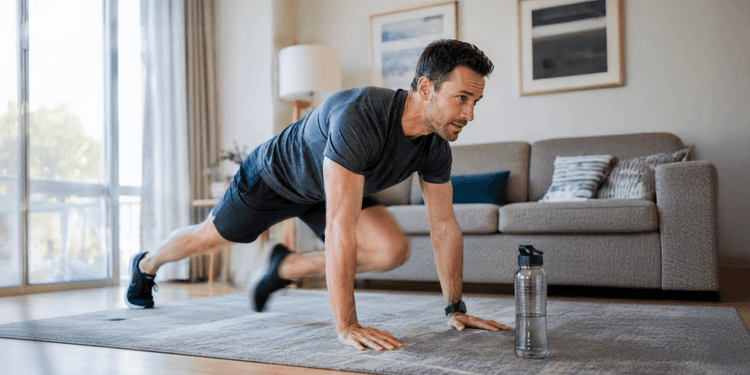
Do these exercises to elevate your pulse while training your core. Starting position: a high plank with hands shoulder width apart, arms fully extended, body in a straight line. Drive your right knee toward your chest while keeping hips level, return your right foot. Then drive your left knee toward your left elbow. Move at a controlled pace, not a sprint. Repeat with the other leg.
Do 3 sets of 20 total (10 each side). To make it more challenging, speed up the tempo or add a push up between sets.
7. Dead Bug (Core Stability)
The dead bug teaches your core to brace while your arms and legs move independently. Lie on your back with knees bent and lifted over your hips. Both arms reaching toward the ceiling. Drop your right arm overhead slowly. Extend your left leg straight. Your lower back should be pressed into the floor. Return to start and switch sides, lowering your left arm and your right leg.
Do 3 sets of 8 reps per side. The slower you move, the harder it gets.
8. Bird Dog (Balance and Back Strength)
It trains balance, posterior chain, and coordination. Start on all fours with hands under your shoulders and knees under your hips. Extend your right arm forward and your left leg straight back at the same time. Your right elbow and left foot should stretch into one long line on the left side of your body. Hold for two seconds. Return to the starting position. Then extend your left arm and right leg.
Do 3 sets of 8 reps per side. Move slowly and resist the urge to wobble.
Your First Full Body Workout Routine
Pick the routine that fits your time and energy today. Both work your whole body.
Routine A: The 15-Minute Starter
Run through all eight exercises in order, one set each. Rest 30-45 seconds between exercises. If you finish under 15 minutes, do a second round.
This is the bare minimum that still counts. A 10-minute workout can effectively boost circulation and brain power, so 15 minutes is plenty for an absolute beginner.
Routine B: The 20-Minute Full Body Circuit
Complete the eight exercises back to back as a circuit with no rest between exercises. Rest 60 seconds at the end of the circuit, then complete 2-3 rounds total. This style is called AMRAP (As Many Rounds As Possible). It is a time efficient way to combine strength and cardio in a single full body workout that hits every muscle group.
A Simple 4-Week Home Workout Plan
Three sessions per week on non-consecutive days. Monday, Wednesday, Friday works for most people. Tuesday and Thursday as active recovery days where you walk or stretch. Weekends off.
Week 1-2: Foundation Phase
Run Routine A (15 minutes) three days per week. Focus entirely on form. If wall push ups feel too hard, stand closer to the wall. If standard squats feel shaky, hold a chair. Form first, reps second.
Week 3-4: Building Phase
Switch to Routine B (the 20-minute full body workout circuit) three days per week. Add 2-3 reps per exercise, or move to a harder version where you are ready. Wall push-ups become incline push-ups. Standard glute bridges become single-leg bridges. Knee planks become full planks.
After four weeks, do harder variations or switch to a longer home workout plan.
How to Build Muscle Mass with Bodyweight Exercises
Building muscle through bodyweight training is not a myth. The key is asking your muscles to do more than they did last time.
Why Bodyweight Training Can Build Muscle Mass
Compound exercises like push-ups and squats engage multiple muscle groups at once. When you train these movements close to failure with good form, the mechanical tension drives muscle growth. Combining strength training with cardiovascular work can also improve muscle tone and increase calorie burn.
Progressive Overload Without Adding More Weight
Four ways to make a bodyweight exercise harder: add more reps, slow the lowering phase to 3-4 seconds, reduce rest between sets, or move to a harder variation. Wall push-up to incline push-up to knee push-up to full push-up. Each step increases the percentage of your body weight your arms have to handle.
Lower Body Add-Ons for Stronger Legs
If your lower body needs more attention, add these moves once a week alongside your full body sessions.
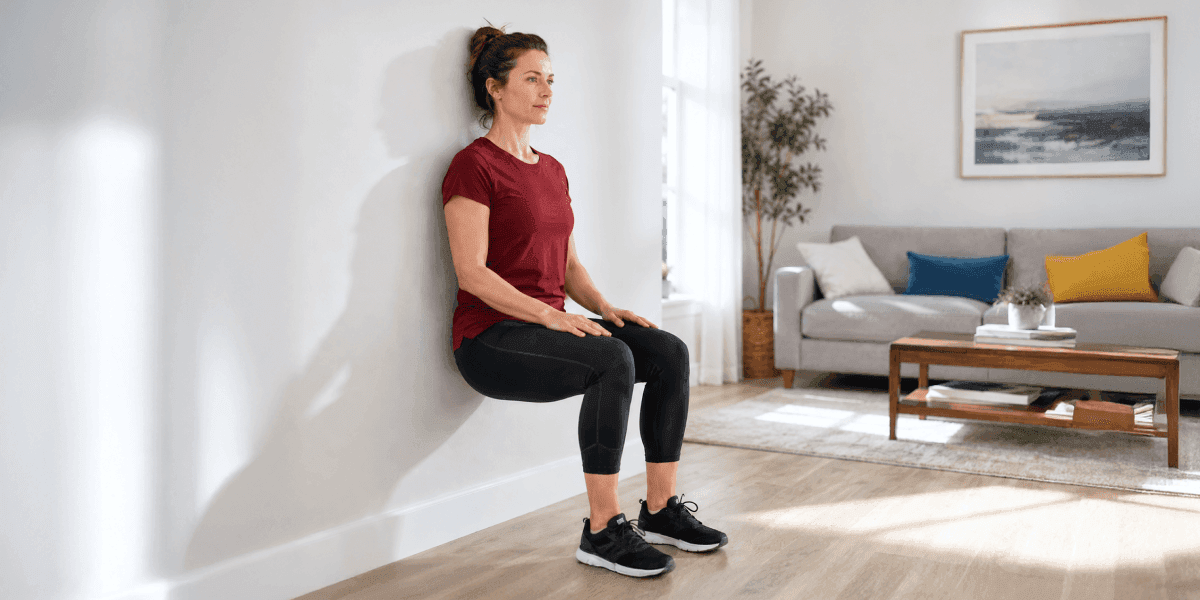
A wall sit holds your legs in a 90-degree squat position against a wall. Start with 20 seconds and build to 60.
A single-leg glute bridge with feet hip width apart isolates one side at a time, helping you find imbalances between your right leg and left leg.
A step up onto a sturdy chair, driving through your right foot then your left foot in alternating sets, trains balance and one leg strength at the same time.
Two of these added to your circuit, once a week, makes a noticeable difference within a month.
Can a Home Workout Help You Lose Weight?
Yes, with one honest caveat. Bodyweight training can be effective for fat loss when combined with proper nutrition and a moderate caloric deficit. No workout will beat a diet that does not support your goal. Weight loss happens in the kitchen first. Workout comes second.
What home workouts do well is make exercise easy to sustain. You train consistently because there is no friction. No commute, no waiting for equipment, no missed sessions because the gym closed early. Consistency over months drives weight loss, not the intensity of any single workout.
Common Beginner Mistakes
The most common mistake is doing too much too fast. Six days a week in week one, then nothing in week three because your knees ache. Three quality sessions beat six rushed ones.
Skipping the warm up is the second mistake. Five minutes is not optional, even on the days you feel ready to go.
Sacrificing form for more reps is the third. Ten clean push-ups beat 20 sloppy ones. Your nervous system learns the pattern you practice, so make sure the pattern is good.
The fourth is comparing your week one to someone else's year three. Run your own pace.
When to Progress to Harder Versions
Move to a harder variation when you can complete every set and rep with good form and feel like you have 2-3 reps left in the tank. If you are grinding out the last reps with shaky form, stay where you are for another week.
For most beginners, progression happens every 2-3 weeks. Tendons and joints need more time to adapt than muscles do, so resist the urge to advance every session. A slow road actually moves faster because you do not get hurt.
How MadMuscles Builds Your Personalized Home Workout Plan
MadMuscles starts with a 4-minute quiz about your fitness level, goals, available equipment, time, and a kind of training you enjoy. The app then builds your plan around your answers, with video demonstrations and voice-guided instructions for every exercise.
You rate the difficulty after each session, and the next workout adjusts automatically. Too easy? The app adds reps or harder variations. Too hard? It scales back. You do not have to figure out progression yourself.
Take the MadMuscles quiz to get a personalized home workout plan that adjusts to your fitness level, your schedule, and the equipment you actually have. For a closer look at what beginners typically get inside the app, see the beginner-friendly workout options.
Start Your First Workout Today
You have everything you need to begin. Eight exercises, two routines, a 4-week plan, and zero equipment. The first session is the only hard one.
Pick Routine A. Warm up for five minutes. Run through the eight exercises at your own pace. Tomorrow you can decide whether to do it again. But today, today you just have to start.