
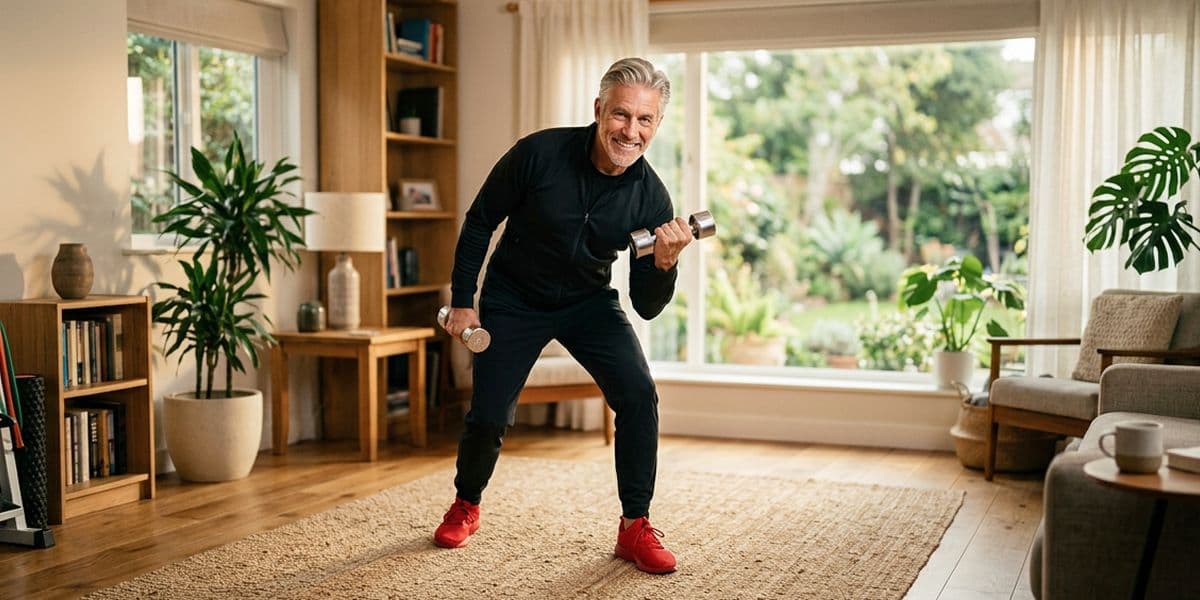
Why Weight Training Matters for Older Adults
Muscle mass naturally decreases with age. Without strength training, this loss can affect everything from gardening to carrying groceries. Weight exercise for seniors counters this decline and helps you stay active well into your 70s, 80s, and beyond.
Regular strength training brings plenty of advantages for older adults and safeguards overall health. It improves muscle strength, which helps with everyday tasks like standing up from a chair, lifting bags, or playing with grandchildren. It also boosts bone density, which is vitally important for reducing the rising risk of fractures and osteoporosis.
Weight training improves balance, too. Better balance makes you less prone to falling, which is one of the biggest health concerns for older adults. Combined with balance exercises like standing on one foot, strength work helps you stay firm.
The benefits go beyond the physical. Strength training improves mental wellness, including reducing symptoms of anxiety and depression. Many seniors report feeling more confident and in control of their bodies after a few weeks of consistent practice. Regular exercise can also lower the risk of heart and circulatory diseases, supporting overall cardiovascular health.
According to CDC recommendation, seniors aged 65+ should engage in moderate-intensity physical activity, like brisk walking, for at least 150 minutes per week with added two days a week of muscles strengthening activities. This guide shows you how to meet that strength goal safely.
Is Weight Training Safe for Seniors?
Yes, weight training is safe for most older adults when done with proper form and the right level of resistance. The key is starting where you are and progressing gradually.
Talk to Your Doctor First
Before you begin any new exercise regimen, speak with a healthcare professional. This step is especially important if you have heart disease, joint pain, balance issues, recent surgery, or any chronic condition. Your doctor can recommend specific exercises that match your current fitness level and flag anything to avoid.
Start Slowly and Build Up
Use light weights at the beginning, light enough that you can complete 10-15 repetitions with good form. If you cannot manage 10 reps, the weight is too heavy. If 15 feels easy, you can move up gradually.
Strength training should feel challenging but should never cause sharp pain. Mild muscle fatigue and a little soreness the next day are normal. Sharp or shooting pain is a red flag meaning you should stop and check with a professional.
Equipment You Need: Resistance Bands and Light Weights
You can build real strength at home with simple equipment. The two most senior-friendly options are resistance bands and dumbbells.
Resistance Bands
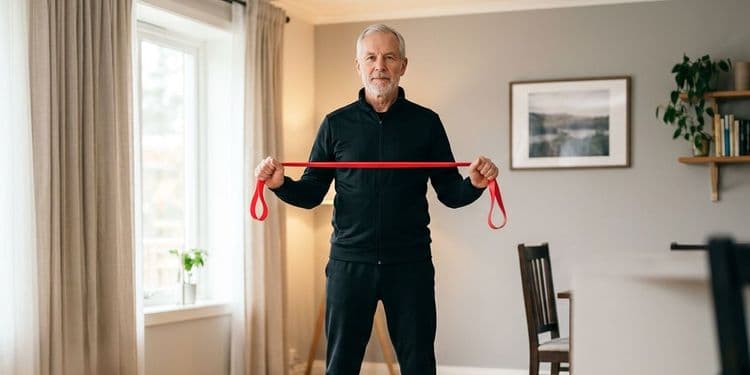
Resistance bands are stretchy elastic bands that come in different tension levels, from very light to firm. They allow seniors to perform exercises with less strain on the joints, which makes them a safer option for many people, compared to traditional weights.
Bands are also affordable, lightweight, easy to store, and travel well. You can use in multiple positions: seated, standing, or lying down. Many resistance band exercises, like the seated row, help improve upper body strength and posture while being light on the joints.
Light Dumbbells
Dumbbell exercises are suitable for home use and versatile. They allow to strengthen various muscle groups without a gym membership. Start with 1-3 pound dumbbells if you are new to weight training. Soup cans or full water bottles can work as a substitute if you are first testing a movement.
Other Useful Items
A sturdy chair or firm chair is essential for many seated exercises and for balance support. A yoga mat adds comfort during floor work like glute bridges and the dead bug. Comfortable shoes with non-slip soles keep are indispensable during standing exercises.
The MadMuscles app lets you choose your equipment level during the quiz. If you have only resistance bands, the app can build your full plan around them. Learn more about the equipment options available.
Warm Up Before Every Session
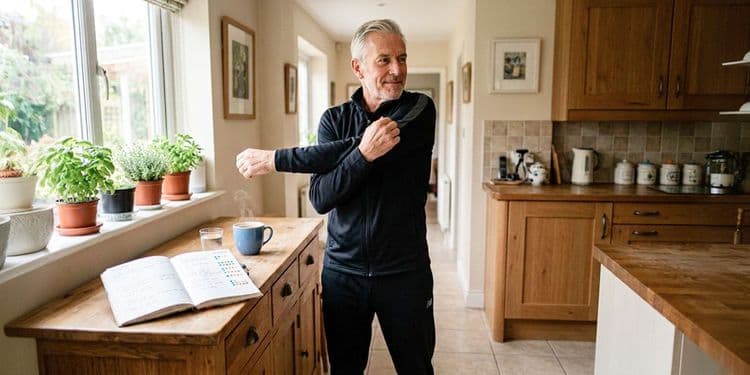
Warming up for 5-10 minutes with walking or gentle stretching lowers the risk of injury. A warm body moves more freely, and your joints respond better to resistance work.
A simple warm-up routine includes:
2-3 minutes of slow walking around your home
Arm circles, 10 in each direction
Light shoulder rolls, 10 forward and 10 backward
Marching in place for 30 seconds, holding a chair if needed
Slow heel raises, 10 reps with support
Side-to-side weight shifts, 30 seconds
Move slowly and breathe normally throughout. If something feels stiff, give it a few extra seconds of careful movement before starting your main workout.
Proper Form: The Foundation of Safe Weight Training
Proper form protects your joints and ensures the right muscles do the work. A few basic principles apply to almost every exercise:
Keep movements controlled. Slowly lift the weight, then slowly lower it. Avoid jerking, swinging, or using momentum.
Breathe through every rep. Correct breathing during strength training involves exhaling while lifting and inhaling while lowering. Holding your breath spikes blood pressure and adds unnecessary strain, so avoid it.
Keep your core engaged. Gently pull your belly button toward your spine to activate your abdominal muscles. This effort protects your back during every movement.
Stand or sit tall. Keep your shoulder blades back and down, your chest open, and your spine in a neutral position. Slouching shifts the load to the wrong places.
Stop if you feel acute pain. Mild fatigue is good. Sharp or shooting pain is not.
8 Best Weight Exercises for Seniors
These exercises target the major muscle groups that matter most for daily life: legs, hips, back, chest, shoulders, arms, and core muscles. Together, they give you a full-body, 25-35 minute workout.
1. Wall Push-Ups (Chest, Shoulders, Arms)
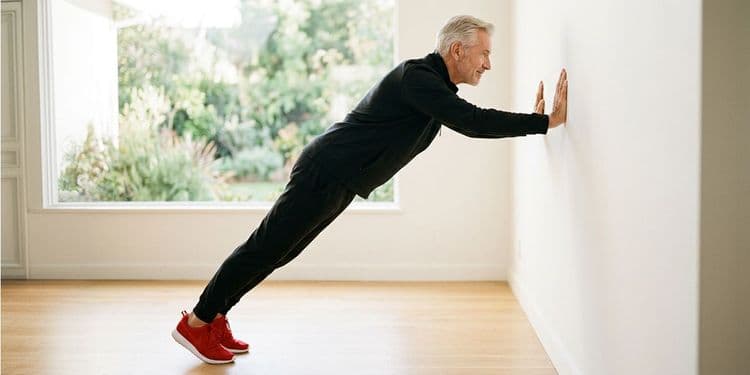
Wall push-ups are a gentle exercise that strengthens the chest, shoulders, and arms using your own body weight, without the strain of doing floor push-ups. That makes them a great fit for seniors.
Starting position: Stand facing a wall, about arm's length away. Place your hands flat on the wall at shoulder height, slightly wider than shoulder width apart. Keep your arms straight and feet shoulder width apart.
Movement: Bend your elbows and slowly lower your chest toward the wall, keeping your body in a straight line from head to heels. Pause for a moment, then push back to the starting position.
Target: 2-3 sets of 8-12 reps.
If wall push-ups get easy, you can take up incline push-ups using a sturdy counter or table.
2. Chair Squats (Legs, Glutes, Core)
Chair squats mimic daily tasks, like getting out of a chair, which makes them one of the most useful leg exercises for seniors.
Starting position: Position your feet shoulder width apart with a chair in front of you. Hold your arms straight out in front of you for balance.
Movement: Lower your hips back carefully as if sitting down. Tap the chair lightly with your bottom, then push through your feet to stand back up. Keep your knees bent in line with your toes, never letting them collapse inward.
Target: 2-3 sets of 10-12 reps.
If needed, hold the back of another chair for balance. As you build leg strength, lower more slowly or skip the tap and pause just above the seat.
3. Heel Raises (Calves and Balance)
Calf raises work on ankle stability and balance. They strengthen the calf muscles that help with walking, standing, and climbing.
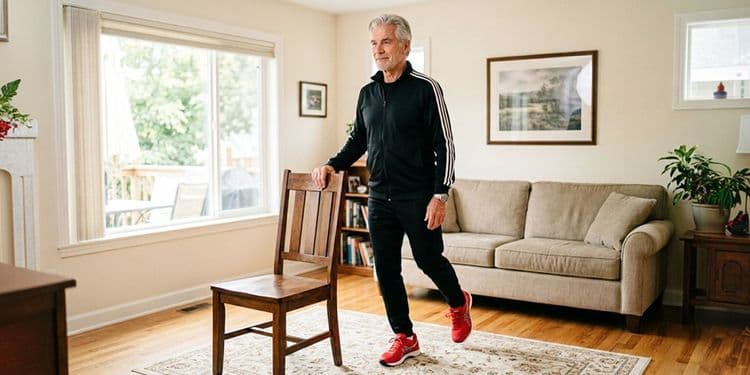
Starting position: Stand behind a firm chair with feet hip width apart. Hold the chair lightly for balance.
Movement: Slowly lift your heels off the floor, rising onto the balls of your feet. Hold for one or two seconds at the top, then lower your heels back down carefully.
Target: 2-3 sets of 12-15 reps.
For an extra challenge, try heel raises on one foot at a time, keeping the other leg slightly lifted and holding the chair for balance. Switch between the right foot and left foot for even practice.
4. Seated Leg Extensions (Quads)
Leg muscles are essential for walking, standing, and other daily activities. Seated leg extensions help strengthen them.
Starting position: Sit tall in a sturdy chair with feet flat on the floor. Support yourself by placing your hands on the seat.
Movement: Keeping the leg straight, slowly extend your right foot out in front of you until your leg is parallel to the floor. Hold for two seconds, then lower gradually. Repeat with the other leg.
Target: 2-3 sets of 10-12 reps per leg.
If you feel like adding more challenge, use a light ankle weight or loop a resistance band around your ankles.
5. Bicep Curls (Arms)
Bicep curls build arm strength for lifting daily objects like grocery bags or water bottles.
Starting position: Sit or stand tall with feet flat on the floor and feet shoulder width apart. Hold a light dumbbell in each hand with arms straight at your sides, palms facing forward.
Movement: Lift the weights toward your shoulders by bending your elbows. Don't rush. Keep your upper arms still and elbows close to your sides. Pause at the top, then lower back to the starting position.
Target: 2-3 sets of 10-12 reps.
A resistance band works well for this movement too. Stand on the band with both feet and hold the handles or ends with palms facing outward.
6. Overhead Press (Shoulders)
The overhead press enhances shoulder mobility and strength. It makes reaching for high shelves and lifting items overhead easier.
Starting position: Sit tall in a chair with feet flat on the floor. Hold a light dumbbell in each hand at shoulder height, palms facing outward, elbows bent.
Movement: Press the weights up overhead steadily until your arms are nearly straight, but do not lock your elbows. Pause briefly, then ease the weights back to shoulder height.
Target: 2 sets of 8-10 reps.
Start with very light weights, even one or two pounds. Shoulders are very sensitive, and good form matters more than the load. If you have shoulder pain, skip this exercise and ask your doctor for alternatives.
7. Glute Bridges (Hips, Lower Back, Core)
Supporting good posture and reducing strain on the knees is an important task. Glute bridges fulfill it by strengthening the lower back, hips, and glutes.
Starting position: Lie on your back with knees bent and feet flat on the floor, hip width apart. Place your arms at your sides, palms down.
Movement: Squeeze your glutes and lift your hips off the floor until your body forms a straight line from shoulders to knees. Hold for two seconds at the top, then lower back down carefully.
Target: 2-3 sets of 10-12 reps.
If getting on the floor is difficult, you can perform a similar movement seated by squeezing your glutes for 5-10 seconds at a time.
8. Dead Bug (Core)
The dead bug exercise builds core stability without straining the back, which is why physical therapists often recommend it for older adults.
Starting position: Lie on your back with arms straight up toward the ceiling and knees bent at 90 degrees. Shins are parallel to the floor. Press your lower back gently into the mat.
Movement: Slowly lower your right arm overhead and extend your left foot toward the floor at the same time. Stop just before they touch the floor, then return to the starting position. Repeat on the other side, lowering your left foot and right arm.
Target: 2 sets of 6-8 reps per side.
Your lower back is on the floor throughout. If you feel your back arching, use a smaller range of motion. Keeping your core engaged is the goal of this exercise.
Sample Weekly Workout Plan
Do the strength training at least two days a week, with at least one rest day between sessions. Here is a simple workout plan for seniors who start weight training:
Day | Activity | Duration |
Monday | Strength training (full body) | 25-30 min |
Tuesday | Brisk walk or gentle stretch | 30 min |
Wednesday | Rest or light walking | 20-30 min |
Thursday | Strength training (full body) | 25-30 min |
Friday | Brisk walk plus balance training | 30 min |
Saturday | Rest or gentle yoga | Optional |
Sunday | Easy walk or stretching | 30 min |
A balanced exercise routine should include strength training, cardiovascular activities, and flexibility exercises. This plan covers all three.
How to Add More Resistance Over Time
Your body adapts to the load you give it. Challenge yourself to keep building muscle strength and bone health.
Use one or more of these methods every 2-4 weeks:
Add 1-2 reps per set when current numbers feel comfortable
Move to a slightly heavier weight or a band with more tension
Slow down each rep, taking 3 seconds to lift and 3 seconds to lower
Add an extra set, going from 2 to 3 sets per exercise
Progress at your own pace. There is no rush, and consistency beats intensity.
Other Exercises to Pair With Weight Training
Weight training works best as part of a broader workout routine. Three other types of physical activity round out your fitness program:
Balance training. Incorporating balance exercises into a fitness routine is crucial for seniors, as balance naturally declines with age. Try standing on one foot for 10-30 seconds. Hold to a chair if needed. Practice on each leg.
Cardiovascular activity. Brisk walking, swimming, or cycling on a stationary bike supports heart health and helps you reach the CDC's 150-minute weekly goal for moderate physical activity.
Flexibility and mobility work. Your muscles and joints keep supple if you includegentle stretching in your routine. Yoga and tai chi are excellent low-impact options that also support balance and mental wellness. The MadMuscles app includes workouts and programs designed for older adults that fit nicely alongside weight training days.
Common Mistakes to Avoid
Even careful seniors can fall into a few habits that slow progress or raise injury risk. Watch out for these:
Lifting too much too soon. Heavy weights with poor form do more harm than good. Start light. Build up over weeks, not days.
Skipping warm-ups. A 5-10 minute warm-up cuts your injury risk significantly. Never go straight into your main workout.
Holding your breath. This raises blood pressure and adds strain. Take a deep breath before each rep, exhale on the lift, and inhale on the lower.
Neglecting recovery. Allow your muscles time to recover. Rest for at least one day between weight training sessions; it prevents overworking your muscles and lets them rebuild stronger.
Pushing through sharp pain. Soreness fades; injuries linger. Stop if anything feels wrong.
Working only one part of the body. A balanced routine targets the upper and lower body, plus the core. Don't focus only on legs or only on arms; both matter for staying active in daily life.
Bone Health and Muscle Strength: Long-Term Benefits
Strength training is one of the most effective tools for maintaining mobility and independence in your later years. The long-term effects compound over time:
Bone density. Weight-bearing exercise stimulates bones to stay strong and reduces fracture risk. This matters especially for women after menopause and for any senior with osteoporosis concerns.
Muscle mass. After age 50, adults can lose 1-2% of muscle mass per year without strength training. Regular weight exercise reverses or significantly slows this trend.
Joint stability. Stronger muscles around your knees, hips, and shoulders ease joint pain and reduce stress on cartilage during everyday movement, helping to stay mobile.
Fall prevention. To reduce fall risk, you needstronger legs, better balance, and improved coordination. Falls are a leading cause of injury in older adults; this is one of the most powerful reasons to lift weights.
Mental wellness. Regular activity boosts mood and sharpens thinking. It also relieves tension built up from inactive days, supporting overall mental wellness.
Start Your Weight Training Journey Today
Weight training gives you a powerful tool for a healthy aging and staying active. With the right exercises, light weights or resistance bands, and a consistent twice-weekly schedule, you can build muscle strength, improve balance, support bone health, and stay independent for years to come.
Start small. Two short sessions a week, with light weights and proper form, deliver true results. Progress comes from showing up consistently, not from going hard on day one.
The MadMuscles app offers personalized workouts designed for older adults, with video demonstrations for every exercise and adjustments based on your fitness level. The quiz asks about your age, goals, and equipment, and then the app builds a routine that fits your life. You can change your workout type at any time as your strength grows.
Pick your first day. Set out a chair, a light pair of dumbbells or a resistance band, and 25 minutes. Your future self will thank you.