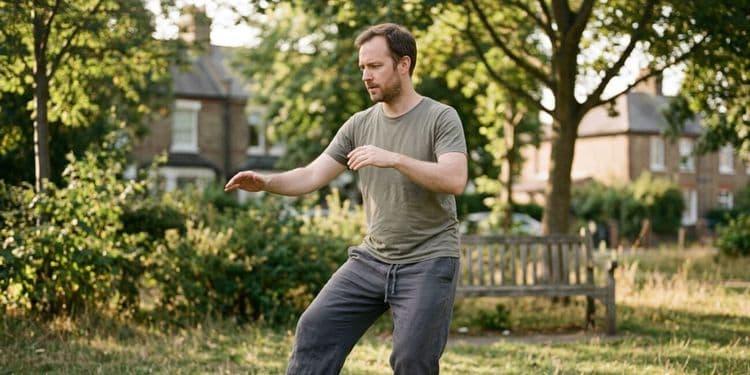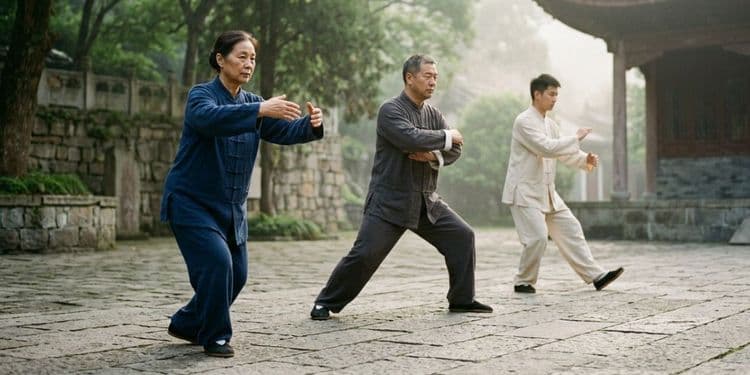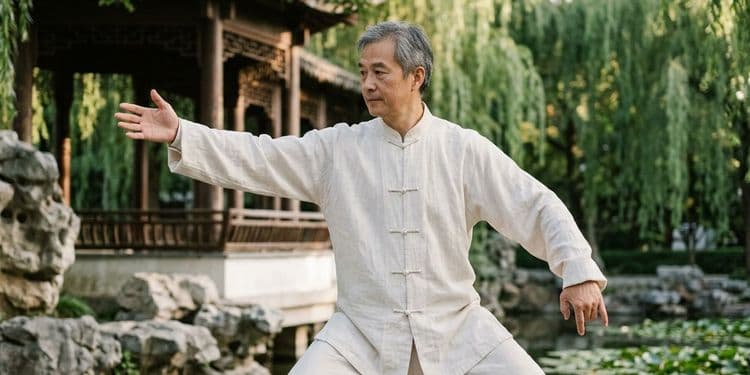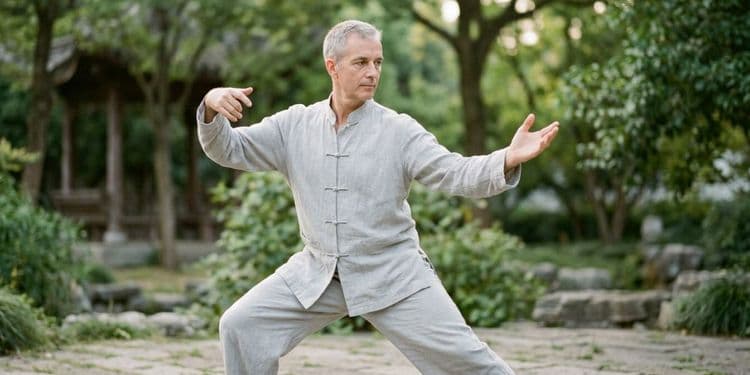

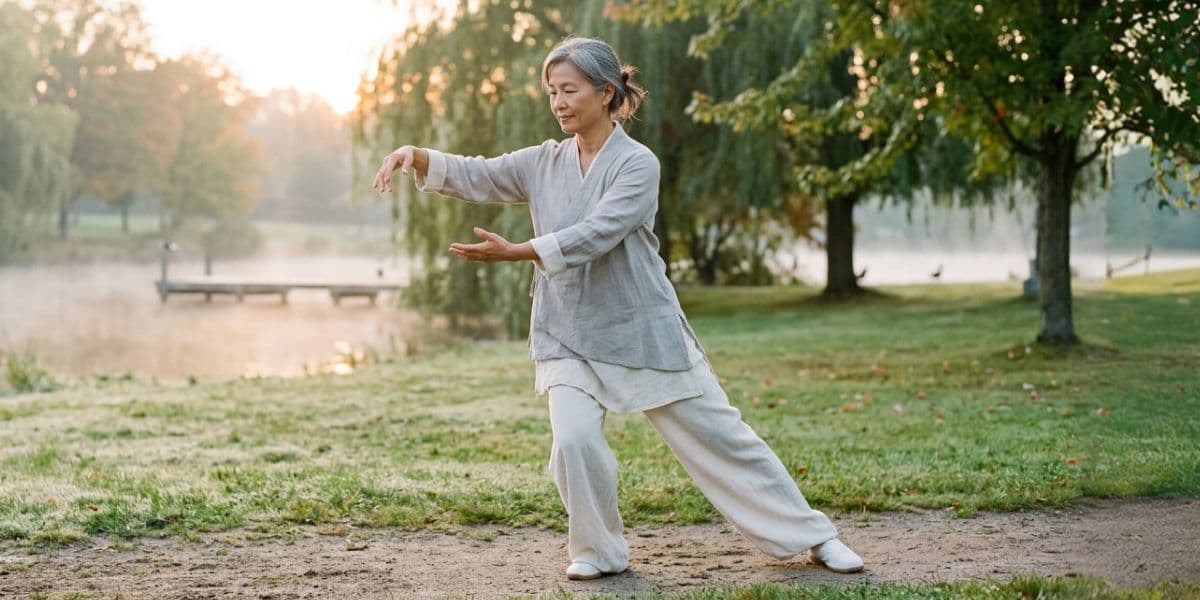
Tai chi is a traditional Chinese practice that combines fluid, deliberate movements, controlled breathing, and a calm, focused state of mind. Often described as "meditation in motion," Harvard Health it is suitable for almost every age and fitness level, from curious beginners to older adults who want a kinder way to stay active.
Developed centuries ago as a martial art, it has become one of the most widely studied complementary therapies in the world, with growing evidence that it supports balance, mood, and many chronic conditions.
In this guide, you will find a clear definition of tai chi, its history, core philosophy, and the five main styles. You'll also learn what a typical session looks like, and which simple steps to take to start practicing tai chi at home.
What is tai chi, in simple words
Tai chi, sometimes spelled t'ai chi or written as tai ji quan, a slow-paced, low-impact discipline rooted in Chinese martial arts and traditional eastern health traditions. You move through a sequence of gentle, circular postures while breathing deeply and paying close attention to how your body feels. Harvard Health Nothing is rushed. Nothing is forced. The goal is not to burn out — it is to feel balanced, relaxed, and awake in your body.
Many people call tai chi a form of meditative practice in motion. That is a helpful picture, because each session trains your mind to stay with your breath and your movement at the same time. The effect is calming for the nervous system Mayo Clinic and gently strengthening for the body. You do not need special equipment, only loose clothing, flat shoes (or bare feet), and a little space to move. Harvard Health
The meaning behind the name
The name comes from the Chinese characters 太極 (tàijí), usually translated as "supreme ultimate." In classical Chinese philosophy, taiji describes the state from which the two complementary forces of yin and yang emerge. Contextualchinese When you add quan (拳, "fist" or "boxing"), you get taijiquan — "supreme ultimate boxing." Medium So tai chi is, at heart, the physical expression of a very old idea: that health and harmony come from balancing opposites — soft and strong, still and moving, empty and full.
A mind-body practice, not just exercise
Tai chi is often called a holistic practice that engages both body and mind. It shares space with practices like yoga and qigong. What makes it distinct is the combination of slow movements, controlled breathing, NCCIH and sequences called forms that you learn step by step. You work the body, quiet the mind, and train coordination all at once. That blend is why researchers often study tai chi as both a physical and a psychological intervention.
The history and origins of tai chi
Tai chi originates from ancient Chinese traditions, but its story is a mix of verified history and fascinating legend. Understanding both helps you appreciate why it feels so layered today.
Ancient roots, the Book of Changes, and the Zhou Dynasty
The philosophical idea behind tai chi is very old. The concept of taiji — the supreme ultimate — appears in the commentaries of the Book of Changes (I Ching), Encyclopedia Britannica a foundational Chinese text whose earliest layers trace back to the Zhou Dynasty (roughly 1046–256 BCE). These writings describe yin and yang as the two primary forces of the universe, Encyclopedia Britannica an idea that later shaped Taoist thought, Chinese medicine, and eventually tai chi itself. The philosophy is more than 2,000 years old. The martial art we now call tai chi, however, was developed much later.
Zhang Sanfeng and Chen Wangting
Tradition credits a legendary Taoist monk named Zhang Sanfeng with creating tai chi after watching a fight between a snake and a crane Jamesmartialartsacademy on Mount Wudang. It is a beautiful story, and it captures the spirit of the art: softness overcoming hardness. Most historians, however, treat Zhang Sanfeng as myth rather than verified history.
The person modern scholars recognize as the historical founder is Chen Wangting (1580–1660), Jamesmartialartsacademy a retired Ming Dynasty military officer Wikipedia from Chen Village (Chenjiagou) in Henan Province. In the seventeenth century, he combined family martial arts, Daoist breathing exercises, and Chinese medical theory into an organized training system. From his village, the art eventually spread outward when Yang Luchan (1799–1872) learned it from a Chen master and began teaching it publicly in Beijing, making tai chi accessible to the wider world.
Philosophy and core principles
To understand why tai chi feels the way it does, it helps to know the ideas it rests on. You do not need to memorize any of this to practice well, but a little context makes each movement more meaningful.
Qi, the body's energy
At the center of tai chi is qi (pronounced chee), often translated as "life energy" or "vital breath." In traditional Chinese medicine, qi is the flow that animates the body. The Way Tai chi's slow, continuous motion is designed to cultivate qi, move it smoothly through the body, and release places where it feels stuck. Western science does not measure qi directly, but the practices that cultivate it — upright posture, deep breathing, relaxation, and gentle movement — produce effects researchers can measure.
Yin, yang, and the Thirteen Postures
Every tai chi movement plays with the dynamic of yin and yang: shifting weight from one leg to the other, softening as you gather, extending as you release. The foundation of this vocabulary is known as the Thirteen Postures — the basic skills from which every form is built. They are made of eight hand methods (ward-off, roll-back, press, push, pluck, split, elbow, shoulder) Egreenway and five footwork patterns (advance, retreat, step left, step right, and central equilibrium). Learning these gives you the alphabet of tai chi.
A meditative movement practice
Tai chi is often called a meditative movement practice Annals of Palliative Medicine because it asks you to stay present with your breath and body throughout every posture. Movements flow smoothly, one into the next, Mayo Clinic without stopping. nih +2 This unbroken quality trains focus, steadies emotions, and is a big reason people describe a tai chi class as calming, almost like a reset button for the day.
The different styles of tai chi
There are five primary traditional different styles of tai chi, each named after the Chinese family that developed it. They share the same philosophical roots and the Thirteen Postures, but they feel different in the body. Choosing among them often comes down to temperament and what is available near you.
Chen style
Chen style is the oldest, created by Chen Wangting in Chen Village in the seventeenth century. It alternates flowing movements with occasional bursts of power (called fajin), uses lower stances, and includes spiraling "silk-reeling" actions. It is athletic and vivid, and it rewards patience. Many newcomers find it exciting to watch and a bit more demanding on the legs.
Yang style
Yang style, developed by Yang Luchan and popularized by his grandson Yang Chengfu, is the most widely practiced tai chi in the world. Movements are broad, steady, and continuous. There are no jumps or sudden releases, Wikipedia which makes Yang style an excellent starting point for beginners and older adults who want a calm, steady tempo.
Wu style
Wu style, founded by Wu Jianquan (1870–1942), grew out of Yang style. It uses a more compact frame and a subtle forward lean, with a straight line running from the back heel up through the spine. Wu style is known for sensitivity, balance, and careful weight transfer, and it is one of the most popular styles after Yang.
Hao style
Hao style (also called Wu-Hao) was created by the scholar Wu Yuxiang (1812–1880). It emphasizes very small, inward movements driven by precise internal intention. It is considered subtle, refined, and advanced. Many teachers recommend it only after you have built a foundation in another style. It is the rarest of the five styles worldwide.
Sun style
Sun style, developed by Sun Lutang (1861–1933), is the youngest of the five. It uses higher stances, lively, follow-step footwork, and open-palm hand shapes. Because it is gentle on the knees and hips, Sun style is often recommended for rehabilitation, for seniors, and anyone who wants a lighter, quicker-paced practice.
How tai chi works and what a session looks like
A typical tai chi class usually lasts about 45 to 60 minutes. Sessions are calmly paced and easy to follow consistently, which is part of why so many people stay with the practice for years. Here is what you can generally expect.
The class usually begins with a warm-up: gentle movements that loosen the neck, shoulders, hips, knees, and ankles, along with some deep breathing to settle the mind. Many tai chi instructors include basic qigong breathing exercises here to open the lungs and quiet the nervous system.
Next comes some standing practice or foundational drills. You might stand in a relaxed "holding a tree" posture for a few minutes to feel your alignment, or practice tai chi walking — a careful, heel-to-toe weight transfer that trains balance and engages the whole lower body. The main body of the session is form practice. Here you move through a choreographed sequence of physical postures NCCIH linked by slow, NCCIH circular transitions, coordinated with natural, controlled breathing. Beginners often start with a short 8- or 24-posture form before working toward longer sequences.
Finally, there is a cool-down. Some classes include light partner work called push hands to practice sensitivity and balance with another person. You leave feeling warmer, taller, and usually a bit calmer than when you walked in.
The health benefits of tai chi at a glance
Tai chi is one of the most researched complementary therapies in modern medicine. The full picture deserves its own article, but here is a realistic overview of the benefits of tai chi supported by today's evidence. Gains are gradual, so expect steady progress rather than dramatic changes overnight.
Physical benefits and fall prevention
Practicing tai chi improves physical function, leg strength, flexibility, and coordination. It is especially well-studied for fall prevention in older adults. A 2019 Cochrane systematic review found that tai chi reduces the rate of falls by about 19% NCCIHNCCIH and the number of people who fall by about 20%. The CDC recognizes tai chi–based programs, such as Tai Ji Quan: Moving for Better Balance, nih as effective fall-reduction interventions. CDC Individual trials have shown even larger reductions, Mahealthyagingcollaborative but pooled estimates are the most reliable.
Lowering blood pressure and cardiovascular disease support
Several systematic reviews suggest that regular tai chi can support lowering blood pressure. A 2024 randomized trial published in JAMA Network Open found tai chi more effective than standard aerobic exercise in reducing systolic blood pressure among adults with prehypertension. PubMed Centraljamanetwork Evidence also points to improvements in quality of life for people living with cardiovascular disease. It is not a replacement for medication, but it is a sensible companion to medical care.
Easing knee osteoarthritis and chronic pain
In 2019, the American College of Rheumatology and the Arthritis Foundation issued a strong recommendation for tai chi in the management of knee osteoarthritis and hip osteoarthritis. Docwire News Studies show it reduces pain and improves function American Academy of Family Physicians at least as well as conventional physical therapy for many patients. Tai chi also has evidence for fibromyalgia (a landmark New England Journal of Medicine trial in 2010) and chronic low back pain.
Chronic obstructive pulmonary disease (COPD) and lung function
For people living with chronic obstructive pulmonary disease (COPD), reviews of more than 20 studies show tai chi can improve exercise capacity, lung function measures, and quality of life Sage Journals compared with usual care alone. Sessions are gentle enough to be sustained over time, PubMed which is often the missing piece in pulmonary rehabilitation.
Mental health and calmer mood
Research has linked tai chi to lower anxiety, reduced depressive symptoms, better sleep quality, and sharper focus. A 2014 meta-analysis led by Dr. Peter Wayne of Harvard Medical School found tai chi modestly improves global cognition in older adults with mild cognitive impairment, and a 2023 trial in Annals of Internal Medicine reported cognitive gains that persisted six months after the program ended. In short, the mental and physical health effects travel together.
Who tai chi is for
One of the best things about tai chi is how inclusive it is. It meets you where you are.
Older adults and people with chronic conditions
Older adults are one of the most-studied groups and one of the biggest beneficiaries. Gentle pace, built-in balance training, and low impact make it a strong fit for retirement years. People living with chronic diseases, including arthritis, COPD, high blood pressure, Parkinson's disease, and heart disease nih often use tai chi as part of an integrative health plan alongside medical care. Always check with your clinician if you have a chronic medical condition, then find a qualified teacher who understands your needs.
Beginners and all fitness levels
If you are new to movement, out of shape, or just intimidated by gyms, tai chi is a welcoming entryway to physical acitvity. There is no jumping, no heavy lifting, and no pressure to keep up. Harvard Health Tai chi participants range from children practicing with grandparents in Chinese parks to office workers, athletes cross-training for recovery, and anyone who simply wants a quieter way to stay active.
How to learn tai chi and get started
Starting tai chi is simpler than it looks. You can move at your own speed and build from almost nothing.
Finding a class or instructor
A live tai chi group is the richest way to learn tai chi, because good tai chi instructors can correct your posture and adjust movements to your body. Look into community centers, senior centers, parks, YMCAs, martial arts schools, and hospitals that offer integrative health programs. Many cities host free outdoor practice in the mornings. If your teacher has experience teaching martial arts but also understands adapting movement for seniors or rehab, that is a good sign.
Learning from videos and starting at home
If a local class is not an option, instructional videos and streamed courses are widely available. Free platforms like YouTube host full beginner forms, and paid programs often guide you step by step through a short sequence over several weeks. Our app can also help you build the consistent daily habit that makes tai chi — and any practice — actually stick.
A gentle daily rhythm tends to work better than long, occasional sessions. Many teachers suggest starting with 10 minutes a day and gradually building to 20 to 30 minutes. Warm up, work on one or two postures, then finish with a few deep, slow breaths. Repetition is the real teacher.
Tai Chi with MadMuscles
The MadMuscles app offers several tai chi programs for different needs and levels. You can choose a program based on your goals and comfort level:
Master Lee's Tai Chi — traditional tai chi with slow, flowing movements for all levels.
Tai Chi Monk Power — a blend of tai chi and QiGong that supports strength and mental clarity.
Tai Chi Walking — a low-impact, mindful walking program based on tai chi principles, great for beginners and older adults.
Chair Tai Chi — seated tai chi practice for people with limited mobility or anyone who prefers to sit while training.
Tai Chi for Golfers — a program focused on balance, mobility, and mental focus for golfers.
Each program is built around video demonstrations with voice-guided instructions. You can practice at your own pace and build a steady routine that fits your day.
Is tai chi safe as a gentle exercise?
For most people, the answer is a confident yes. Tai chi is a gentle exercise that is low-impact, non-jarring, and adjustable to any level. A 2019 safety review of 24 studies with nearly 1,800 participants reported only minor, short-lived issues (such as temporary muscle soreness) and no serious adverse events attributed to tai chi.
That said, a few common-sense precautions help. If you have had joint surgery, a recent fall, severe balance problems, heart conditions, or pregnancy complications, talk with your doctor before starting tai chi. Skip or adapt low stances if your knees complain. Practice on a non-slip surface. Stay hydrated in warm weather. And if something hurts, ease off. Tai chi should feel challenging but never painful.
Tai chi vs other practices and exercises
Tai chi is not a replacement for everything you do. It is one tool in a well-rounded movement life.
Tai chi vs yoga
Yoga and tai chi are often compared because both are mind-body disciplines. Yoga typically holds still postures and stretches, while tai chi keeps moving continuously through flowing sequences. If you love stretching and breath work in held poses, yoga may feel more at home. If you prefer a steady, dance-like flow with a balance-training focus, tai chi is a natural fit. Many people enjoy both.
Tai chi vs aerobic exercise and strength training
Tai chi is closer in spirit to walking exercises than to running or cycling. It offers light aerobic conditioning — enough to support cardiovascular health in less-active adults, but it will not replace dedicated aerobic exercise if you want higher fitness levels. Harvard Health Likewise, tai chi builds functional leg and core strength, yet it is not a substitute for strength training or resistance training when your goal is muscle growth. A smart plan would often combine tai chi for balance, breath, and calm with walking or cycling for stamina and some upper body or full-body strength work for bone and muscle. Each supports the other.
Frequently asked questions about tai chi
Is tai chi a martial art?
Yes. Tai chi began as one of the Asian martial arts, a Chinese internal boxing style. Harvard Health Most people today practice it for health, but the postures still carry martial meaning, and some schools teach applications and partner work.
Can beginners really do tai chi?
Absolutely. Tai chi is designed to start gently. Most classes welcome complete beginners, and a good teacher will introduce one movement at a time. The learning curve is kind.
How long does it take to learn tai chi?
You can learn a short beginner form in a few weeks of consistent practice. Memorizing a full traditional form usually takes several months to a year, and deepening your skill is a lifelong path. You do not need to master the whole form to enjoy the benefits, even a few postures practiced daily count.
Is tai chi religious?
No. Tai chi draws on Taoist philosophy and traditional Chinese thought, but it is not a religion and does not require any specific belief. People of all backgrounds practice it comfortably.
How is tai chi different from yoga?
Yoga emphasizes held postures, stretching, and breath work. Tai chi emphasizes continuous, flowing movement with a balance and martial arts heritage. Both support flexibility, relaxation, and psychological well-being, but they feel distinctly different in the body.
How often should I practice?
A short daily session is ideal. Ten minutes a day is a fine beginning. Twenty to thirty minutes most days of the week is a common target for lasting results.
Takeaway: a calm path forward
Tai chi is an unusual gift from ancient China to modern life: a slow, thoughtful practice that asks very little of you on day one and gives more back the longer you stay with it. Its history blends legend and documented scholarship, its philosophy weaves together yin and yang, qi and the Thirteen Postures, and its family of different styles offers a version for nearly every body and preference.
Research from the CDC, NIH, Harvard Health, and the ACR shows real promise for balance, blood pressure, osteoarthritis, COPD, chronic pain, and mood with gentle, steady gains rather than dramatic transformations.
If you are curious, try ten quiet minutes tomorrow morning. Stand tall, breathe deeply, shift your weight slowly from one foot to the other, and notice how your body feels. That is already tai chi. Everything else is just patient, friendly practice on top of that first calm breath.